
Tensions at UMaine rise as workers call for a stop to layoffs
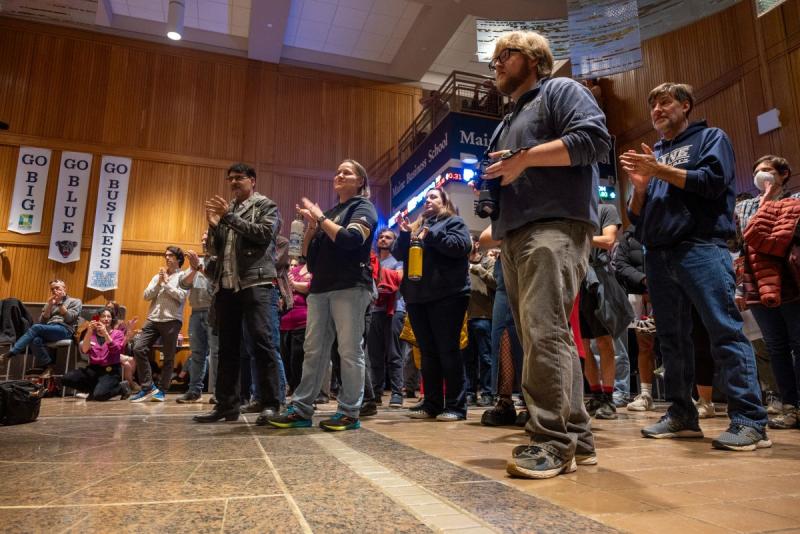 Faculty, lawmakers, students and staff gathered in the Donald P. Corbett Business Hall Atrium on UMaine's campus on Monday to call on university leaders to not cut faculty and staff. Photo by Kristian Moravec.
On Monday night, lawmakers, students and unions that represent faculty, part-time staff, graduate students and other professional staff at the University of Maine called on leaders to stop layoffs that were announced in September.
In a packed hall on campus, the groups called for UMaine leaders to consider all options before committing to cuts to faculty and staff, including advocating for more state funding, which both UMaine officials and unions previously said has declined. The groups also said that a loss of faculty and staff will harm students and would be a temporary solution to broader budget problems.
“What exactly are students supposed to get less of? Less feedback on their work, less help finding the courses they need to graduate, longer waits for counseling, fewer people answering their financial aid questions?” State Rep. Amy Roeder, D-Bangor, who is also an adjunct professor at UMaine, said at the event. “Because when you cut the people who do those things, those are the choices you’re making.”
The public university announced last month that it faced a $19-million budget gap for its 2028 fiscal year, which starts in July. It said it planned $10 million in cuts to academic affairs, including layoffs of faculty and staff, to help close that gap. It is not yet clear how many workers will lose their jobs.
Last week, the university announced more cuts to non-academic units, such as consolidating research centers and reductions within the president’s office. It also said it anticipates increased revenue from its food services provider, Sodexo. In all, these possible reductions account for an additional $6 million of the $19-million shortfall. The university still must find another $3 million before it submits its budget to the University of Maine System Board of Trustees next semester.
But on Monday night, some questioned whether university leaders were doing enough to explore alternatives to layoffs.
Sara Abronze, president of the Universities of Maine Professional Staff Association, said that there should be a full review of administrative costs at both UMaine and the system that oversees all of the state’s public universities.
“This issue should have been discussed with our labor unions first,” she said. “Those of us who support students, manage grants, run the labs and do the grind level work are being asked to shoulder the burden of a budget we did not break.”
State Sen. Michael Tipping, D-Orono, who is up for reelection this November, also said at the gathering Monday night that the state needs to invest more in public universities.
“There are legitimate and important debates about how money is spent on campus, who benefits, how much administrators are paid, who shoulders proposed costs,” Tipping said. “But we also need to acknowledge that we have been systematically underfunding public higher education in this state for decades.”
Financial challenges aren’t new to the university. Last December, university officials announced that it would need to make budget cuts to address an $18-million shortfall for the current fiscal year, on top of the shortfall for next year, which it addressed with a 7 percent cut across the board.
The state’s flagship school has also faced criticism during its multi-year process to plan for the university’s future and address major budget concerns, such as enrollment cliffs and more than $1 billion in deferred maintenance. Some staff and faculty told The Maine Monitor that they felt the process lacked transparency and that leaders were making decisions without their input. University leaders responded at the time to say the process involved hundreds of people across campus and that there were multiple opportunities for input.
Last spring, faculty sent a letter to University of Maine System Chancellor Dannel Malloy, UMaine President Joan Ferrini-Mundy and the system’s board of trustees, raising concerns about the university’s future and how decision making was unfolding.
In September, the Faculty Senate — a group of faculty that oversees academic policies at UMaine — also passed a resolution urging administrators to work with the representative body during the budget process, such as by including faculty before decisions are finalized, transparency with financial details and calls to explore options that do not involve layoffs. A few days later, the Faculty Senate also produced a list of 36 questions, including budget requests and detailed enrollment models.
In a response to the resolution that was sent to the Faculty Senate last week, university officials stated that the senate was a “consultative body, not a deliberative one” and that faculty can get involved in the budget process, such as through specific finance committees in the Faculty Senate and during the spring budget town Hall.
“We stand ready to provide university-wide updates on the budget preparation processes as they are relevant, and will seek input and consultation with the Faculty Senate Executive Committee and leadership in determining how to take up issues as appropriate through shared governance processes,” the letter read. “We reiterate that it is not the role of the Faculty Senate to ‘review’ proposed budget actions; that is the purview of the University Administration, the University of Maine System, the Board of Trustees Committee on Finance, Facilities, and Technology, as well as the full BOT.”
Graduate student union vice president Peter Howe said it was a blow to hear that faculty and staff are on the chopping block, especially since, in his view, staff and faculty are already stretched thin. Howe said that UMaine leaders have not shown unions that they have looked at other options first before deciding on cutting staff and faculty. He also said there needs to be more transparency about why cuts are needed.
“We’ve had many, many listening sessions, many, many town halls, and yet our input is really not taken into consideration,” Howe said. “We really want a seat at the table. We don’t just want to be listened to.”
This story was originally published by The Maine Monitor, a nonprofit civic news organization. To get regular coverage from The Monitor, sign up for a free Monitor newsletter here.