
Sturgeon get ready to head out into the Atlantic Ocean
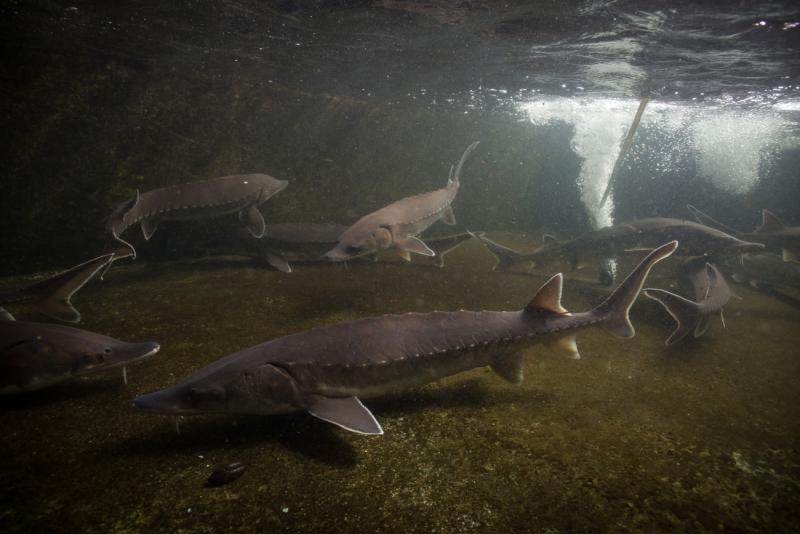 Atlantic sturgeon (Photo courtesy Ryan Hagerty/USFWS)
Atlantic sturgeon (Photo courtesy Ryan Hagerty/USFWS)
Atlantic sturgeon (Photo courtesy Ryan Hagerty/USFWS)One of the less visible things happening in Penobscot Bay this time of year involves one of the river’s most remarkable fish — the Atlantic sturgeon.
Researchers tracking subadult Atlantic sturgeon in the Penobscot River found that the fish typically return to the estuary in the spring and early summer and spend much of the summer using the brackish portion of the river.
Then, around this time of year, they start heading back toward the ocean.
In a seven-year study of Atlantic sturgeon in the Penobscot River, the average date that tagged fish left the estuary was August 31. Individual fish varied quite a bit — some left earlier and some stayed into the fall — but late August marks an important part of that seasonal transition.
And once they leave the Penobscot, they can really travel.
Tagged sturgeon from the Penobscot have been detected throughout the Gulf of Maine and beyond, from the Hudson River in New York to the Minas Basin in Nova Scotia. Even more remarkable, more than 95% of the tagged fish studied returned to the Penobscot the next year.
That is a pretty remarkable journey for a fish that many of us will probably never see.
It is also a good reminder that the Penobscot estuary is not simply a highway between the river and the sea. For Atlantic sturgeon, it is an important seasonal habitat in its own right.
Learn more about the study completed by research scientists from the University of Maine and Maine Department of Marine Resources: Atlantic Sturgeon Use of the Penobscot River and Marine Movements — Marine and Coastal Fisheries
Seth Walton is a member of the nonprofit Penobscot Bay Waterkeeper,whose mission is to, "boldly advocate for the health of the Penobscot Bay Watershed through science, public action, and community engagement."