Policing the oceans: U.S. flexes maritime muscle
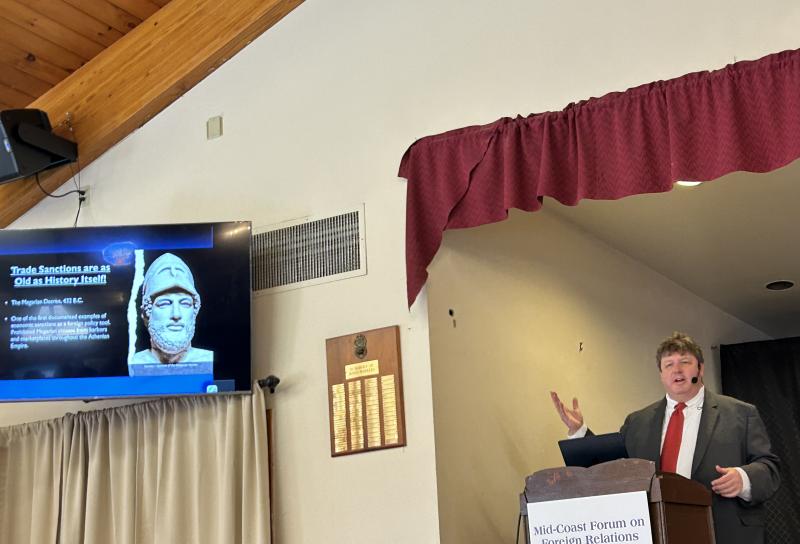 George Chalos is the principal and founding member of Chalos & Co, P.C. Chalos has practiced international maritime, admiralty and regulatory law for almost 30 years, and spoke March 30 at a regular gathering of the Mid-Coast Forum on Foreign Relations in Rockland. His topic: "Anchoring Power – The Rise of the US as Global Enforcers in the Maritime Industry."
George Chalos is the principal and founding member of Chalos & Co, P.C. Chalos has practiced international maritime, admiralty and regulatory law for almost 30 years, and spoke March 30 at a regular gathering of the Mid-Coast Forum on Foreign Relations in Rockland. His topic: "Anchoring Power – The Rise of the US as Global Enforcers in the Maritime Industry."
George Chalos is the principal and founding member of Chalos & Co, P.C. Chalos has practiced international maritime, admiralty and regulatory law for almost 30 years, and spoke March 30 at a regular gathering of the Mid-Coast Forum on Foreign Relations in Rockland. His topic: "Anchoring Power – The Rise of the US as Global Enforcers in the Maritime Industry."A recent talk spotlighting U.S. maritime policies — and actions — at the monthly Mid-Coast Forum on Foreign Relations, in Rockland, could not have been more timely, given the tensions and a U.S. blockade in the Strait of Hormuz.
George Chalos, an attorney, litigator and founding principal with the law firm Chalos and Company, holds a deep understanding of, and association with international, national, and state maritime law. He stood at the podium March 30 at the Rockland Elks Club, capitivating a roomful of Forum members and guests with his 3,000-year overview of maritime power strategies and tactics, with a focus on the United States.
"The U.S. exercises jurisdicition over numerous regulatory and legal issues which happen in international waters or foreign shores, despite a general rule in the U.S. against extraterritoriality," said Chalos, who is sometimes called in the middle of the night for consultation with D.C. leaders seeking arcane knowledge of the maritime industry.
Chalos has spades of that, and as he spoke, the layers of U.S. maritime maneuvers were peeled back, starting with federal seizures of ships that violated the Slave Trade Act of 1800, to the War of 1812, when the U.S. issued sanctions agains the U.K. for, "harrassment of American sailors," said Chalos.
The title of his March 30 talk was "Anchoring Power – The Rise of the U.S. as Global Enforcers in the Maritime Industry."
Maine has historic exposure to maritime battles, skirmishes, surveillance and enforcement, from the 1600s when battles between the French and British were fought over territory, to the Revolutionary War, and then World War II and threats of offshore enemy submarines. Penobscot Bay alone has seen its share of maritime violence.
And for a time, the Maine coast was an international shipping trade destination — Portland, Searsport, Castine.
Penobscot Bay is also home to Maine Maritime Academy, in Castine, with its graduate program in international logistics management. The University of Maine School of Law, Portland, has a curriculum dedicated to the Center for Oceans and Coastal Law, focusing on law and policy of the oceans.
Ocean policies does not mean just establishing and defending territorial boundaries. It includes Marpol (International Convention for the Prevention of Pollution from Ships), adopted in 1973 and beefed in 1977 following tanker spills and pollution. And it includes MARAD, the U.S. Department of Transportation's Maritime Administration.
Chalos, who is admitted to practice in the Supreme Court of the U.S., has a wide overview of the global maritime order, its industries and commerce. His firm handles, "complex maritime problems of all type, including but not limited to casualties, pollution incidents, alleged Marpol violations (civil and criminal), charter party disputes, cargo claims, defense of P&I and vessel owners’ interests, vessel arrests and attachments, Rule B attachments of electronic fund transfers (EFTs), maritime liens, collisions, salvage, personal injury defense, agents’, stevedores’, shipbroker and terminals’ defense, general average, financing, sale & purchase vessels, regulatory matters, license suspension and revocation proceedings, maritime product liability, and all aspects of marine insurance, reinsurance, coverage and litigation," the company website states.
"We also regularly provide advice to ship owners, operators, shore-side management, shipboard staff and transporters of oil, hazardous products, and insurers about developing early response systems and implementing effective environmental compliance programs aimed at ensuring awareness and compliance with International, U.S. Federal, State and local governmental regulations."
To Chalos, U.S. maritime matters, "often involve questions of national importance."
Hence, in the early 1800s, U.S. maritime law became federal in scope and application, with a strong grounding in English Admiralty law, developed when Great Britain commanded the seas.
"They have hundreds of years of maritime law, and so we borrowed it, as much as we liked to borrow at that point in time," he said.
Sanctions are long-used tools for positioning the U.S. in international politics under the umbrella of national security, foreign policy and economic health.
"Does it get any broader than that," he asked.
"How does the U.S., without an identifiable U.S. flag fleet, do it," he asked. "Just take a deep breath and think about it. Money. The dollar. In international trade and transport, the U.S. dollar is the lingua franca of international business."
But where are the bluewater ships registered?
"The number one ship registry in the world is Liberia; 80 Broad Street, Monrovia, Liberia," he said. "It has to be the biggest office building on the planet," he added, sardonically. "There are thousands of companies there. Liberia has over 260 million gross tons and 5,100 ships. They have taken over recently from Panama."
But where is the Liberian registry headquartered?
"It is not 80 Broad Street, Monrovia, Liberia," said Chalos. "It is at Indian Creek Drive, Dulles, Virginia."
The same holds for the Marshall Islands, which follows Panama and is the country with the third most registered blue water vessels. That office is not on an atoll, he said. Its office, too, is in Virginia, in Reston.
"Now you see the connection of how the U.S. has become a prime enforcer in the maritime world," said Chalos.
The Port of New York and New Jersey, ports in the Gulf and on the West Coast —Los Angeles and Long Beach — are massively relevant to world maritime trade.
"With all that as the backdrop, and I ask the question, slightly rhetorically: Is it a bridge too far? Is it too much for the U.S. to exercise regulatory and enforcement jurisdiction on a worldwide basis? What makes us the policeman of the world?"
Back to the basic tension between the rule against extraterritoriality while assuming jurisdiction in international waters. And the distinctions between court-ordered seizures and piracy.
The extent of U.S. sanctions controls is wide, as Chalos cited various statutes, and moved into Iranian oil money, and funding of the Iranian regime and Hezbollah.
The high value is the cargo, not the ships themselves, which are, "deteriorating assets," Chalos called them.
The U.S. is boarding and confiscating vessels and ships on the high seas, with court warrants. Are there other countries acting as enforcers?
"Yes, there are, but not to the same extent," said Chalos. "We know certain port states take interest in certain misconduct on the high seas but it is kept fairly limited to domestic enforcement of issues that occur much closer to home. We are, I would say, out on a limb with what we do.... On one hand, we are industry leaders, and on one hand we might be out on a limb. I am not quite sure."
Reach Editorial Director Lynda Clancy at lyndaclancy@penbaypilot.com; 207-706-6657