
Maine sewage sludge crisis is ‘still under a clock’ even if landfill expands
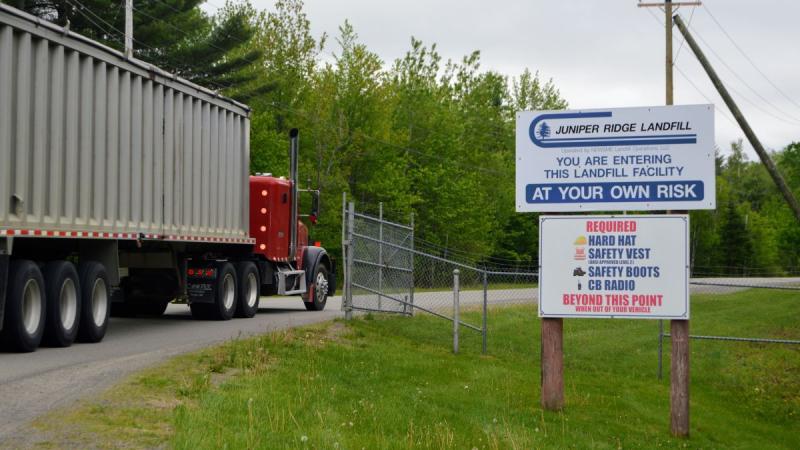 A truck passes through the entrance in Alton to Juniper Ridge Landfill on May 28, 2026. Photo by Erin Rhoda.
A truck passes through the entrance in Alton to Juniper Ridge Landfill on May 28, 2026. Photo by Erin Rhoda.
A truck passes through the entrance in Alton to Juniper Ridge Landfill on May 28, 2026. Photo by Erin Rhoda.The proposed expansion of the Juniper Ridge landfill in Old Town and Alton comes as Maine grapples with where to put the PFAS-contaminated sludge that piles up each day at municipal wastewater treatment plants.
The landfill’s application for an expansion license is being processed by the Maine Department of Environmental Protection, which recently determined for a second time that the expansion would have a public benefit. That determination remains under an ongoing appeal brought by the Penobscot Nation and the Conservation Law Foundation who argue that air and water pollution from the landfill is an environmental injustice to the surrounding communities and to the Penobscot River, which is central to the Penobscot Nation’s way of life.
Juniper Ridge currently handles about half of the state’s total landfilled waste and about 90 percent of the state’s sewage sludge, the biosolids strained out of wastewater. Three years ago, when the facility suddenly stopped accepting sludge for several months — saying the landfill’s structural integrity was at risk — Maine got a preview of a potential crisis.
The landfill is once again accepting sewage sludge but is set to reach capacity for all types of waste in 2028. If approved, the proposed 61-acre expansion would extend the facility’s capacity for approximately another decade.
The expanded landfill would be able to accept sludge at a similar rate as it does now until about 2040, according to Maine Department of Administrative and Financial Services spokesperson Sharon Huntley. The state owns Juniper Ridge, but it is operated day to day by NEWSME, a subsidiary of the publicly traded company Casella Waste Systems.
“From a biosolids perspective, the expansion would help ensure there is a long-term, secure, in‑state option available for the responsible management of material that can no longer be beneficially reused based on the banning of land application by the state legislature,” Casella spokesperson Jeff Weld wrote in an emailed statement.
Forever chemicals on farmland
Sewage sludge had long been spread on farmland as fertilizer. But testing over the past decade has revealed the practice was contaminating land with PFAS (per- and polyfluoroalkyl substances), often called forever chemicals. Some of these chemicals have been linked to a variety of health harms including increased risk of some cancers.
PFAS find their way into wastewater in large part because they are ubiquitous in everyday products such as food packaging, nonstick cookware, textiles, toiletries and outdoor gear. PFAS are also often concentrated near airports and military bases that have routinely used firefighting foam containing the chemicals.
In 2022, Maine became the first state to ban the spreading of sludge on land. So wastewater treatment plant operators had to send their sewage sludge to landfills, which in Maine by and large has meant Juniper Ridge. The practice has had “a significant impact in recent years” on the landfill’s capacity, according to the latest Maine Materials Management Plan for Solid Waste and Recycling, published in 2024.
According to Casella, the landfill operator needs to balance out wet sludge with more solid bulking material such as construction debris, furniture and appliances. Casella had been sourcing much of this type of waste from other states, but, in 2022, the Maine Legislature also banned imports of waste from out of state. Ultimately, because of the sewage sludge crisis, Maine allowed Juniper Ridge to continue importing waste from out of state to use as bulking material until 2027.
Expanding the landfill would help with the immediate problem of where to put sludge, said Rob Pontau, general manager of the Brunswick Sewer District. But it’s not a long-term fix.
“We’re still under a clock,” he said.
From sewage sludge to landfill leachate
Once sewage sludge arrives at Juniper Ridge, the PFAS pollution isn’t over. When rain and snow enter landfills, that water mixes with whatever is in the landfill to create a liquid called leachate.
“The leachate is poisoned with a wide array of contaminants, no doubt, but certainly with forever chemicals, with PFAS,” said Nora Bosworth, a staff attorney at the Conservation Law Foundation.
Juniper Ridge sends its leachate to the wastewater treatment plant at the closed Nine Dragons paper mill. That facility does not treat the wastewater for PFAS before discharging it into the Penobscot River, which is at the heart of the Penobscot Nation.
“There is this constant ongoing cycle of toxic liquid being pumped from Juniper Ridge landfill ultimately into the Penobscot River, which then poisons the ecosystem there,” Bosworth said.
“We just feel like the landfill has been disproportionately affecting the tribe here since it was put in,” said Chuck Loring, director of the Penobscot Nation’s Department of Natural Resources.
“There’s a population of people here that rely on this area for subsistence. I think that’s another important consideration,” he said, “that needs to be weighed more heavily.”
During its public benefit reviews, the Maine Department of Environmental Protection found that the proposed expansion would only ensure environmental justice for the surrounding community, including the Penobscot Nation, if Casella installs a PFAS treatment system for the landfill’s leachate.
The petition by the Penobscot Nation and the Conservation Law Foundation criticized this PFAS treatment condition as insufficient, saying the department’s requirements for Casella are “far too broad” and would not provide the public with enough transparency about the effectiveness of the treatment technology the company chooses to use.
Loring wants more details about what kind of treatment Casella is proposing to use, as well as more time to study and understand what effects PFAS from the leachate are having on water quality and wildlife in the river.
“Landfills need leachate treatment systems for PFAS. There’s no question,” said Bosworth. “It’s just that at this point it is disingenuous, it is false, to pretend that a PFAS treatment system is going to erase the harm that Juniper Ridge landfill will cause the Penobscot River. It will at best dampen the harm.”
Even if the Juniper Ridge landfill does expand, it may not be the primary destination for Maine’s sewage sludge for much longer if wastewater treatment plants begin rerouting their sludge to a forthcoming biosolids drying facility.
The state’s first drying facility is set to open this year at the Crossroads landfill in Norridgewock, owned by Waste Management. When fully operational, it should have capacity to receive and dewater 80 percent of the sewage sludge from Maine’s municipal wastewater treatment plants. Once dry, the biosolids would take up far less space and would remain at the Crossroads landfill long-term.
But many wastewater plants have contracts to dispose of their sludge with Casella through the end of 2026 or 2027, according to Pontau, which could delay widespread use of the drying facility.
Pontau is also the current president of the Maine Water Environment Association, an industry group for wastewater treatment systems. The group recently published a report on the need for proactive, longer-term solutions for sewage sludge.
While the new drying facility at Crossroads “adds necessary processing capacity,” the report said, “relying on a single commercial entity for statewide management creates a monopoly-like dynamic with questionable redundancy. It leaves utilities vulnerable to price dictation and operational bottlenecks.”
Multiple regional facilities across New England are needed, Pontau said, adding that “sludge doesn’t care about a state line or a county line or a town line.”
Ultimately, he said PFAS needs to be dealt with at the source.
“If we’re going to set limits on how we deal with it on the back end, then we’ve got to stop making it in the first place,” Pontau said.
Bosworth agreed. “The most important change we can make as a society is: Keep banning PFAS upstream,” she said. “As long as we’re trying to tackle it downstream in our sewage, in our waste, we’re going to be fighting a losing battle.”
This story was originally published by The Maine Monitor, a nonprofit civic news organization. To get regular coverage from The Monitor, sign up for a free Monitor newsletter here.