
Maine Conservation Voters releases 2026 Environmental Scorecard on how legislators voted

Maine Conservation Voters (MCV), an environmental nonprofit working to protect the health of Maine people and the environment, released its 2026 Environmental Scorecard Sept. 3.
The Environmental Scorecard has been a guide to Maine legislators’ voting records on environmental and democracy bills for 40 years.
This year, a total of 60 lawmakers across both chambers earned 100% scores on Maine’s Environmental Scorecard, earning the title of Conservation Champion. Meanwhile, six representatives scored ZERO on the Scorecard, voting against environmental protections, clean energy, and efforts to address rising utility costs.
“Maine’s elected leaders stepped up to the plate this year in a big way,” said Sarah Woodbury, Legislative Director for Maine Conservation Voters, in a news release. “Strong and effective leadership from Augusta is crucial at this moment as the federal government pursues an increasingly anti-environment agenda. The Maine legislature and governor rose to the challenge in 2026, passing laws to help shield Mainers from rising utility costs, expand access to clean energy, and fund land conservation projects in Maine.”
VIEW: 2026 ENVIRONMENTAL SCORECARD
This year’s scorecard grades Maine legislators on their votes on seven key environment and democracy bills from the 132nd legislative session, ranging from protecting Maine communities and people from data centers to understanding the costs of climate change-fueled extreme weather and promoting dark skies across Maine.
The end of the 132nd session was also the final session of Gov. Mills’ tenure, and this scorecard provides a retrospective on the accomplishments and shortcomings of the Mills administration and her climate and environmental legacy.
MCV also shared its perspective on several unscored, yet important bills, in the “Story of the Session.” These include advancements in addressing rising utility costs, prioritizing public and environmental health, and more.
Highlights of the 2026 Environmental Scorecard:
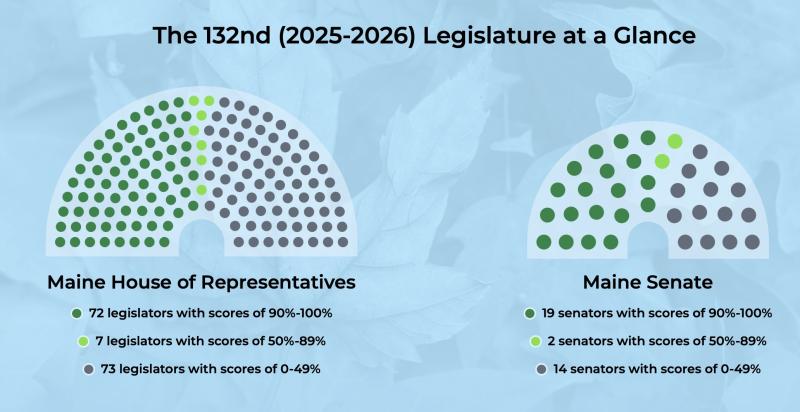
Of the 35 Maine State Senators scored in 2026…
- 19 legislators scored 90-100%
- 2 legislators scored 50-89%
- 14 legislators scored 0-49%
Of the 152 Maine State Representatives scored in 2026…
- 72 legislators scored 90-100%
- 7 legislators scored 50-89%
- 73 legislators scored 0-49%
- - - - - - - - -
Bills scored from 2026 include:
Expand access to clean, affordable solar energy
LD 1730: This bill updates Maine’s rules to allow residents to use portable, plug-in solar arrays, without the red tape and requirements designed for large rooftop solar or any cost to the state or other ratepayers.
Understanding climate impacts
LD 1870: This bill directs the Maine Department of Environmental Protection (DEP) to conduct a comprehensive study to assess and document the financial damage to Maine from climate change, including impacts on public infrastructure, natural resources, agriculture, economic development, and more.
Addressing rising utility costs and energy fairness
LD 1949: This bill requires the Public Utilities Commission (PUC) to consider the affordability of electricity as a central concern in their rate-making, creating an “affordability” metric. Second, it requires that the PUC makes widely available and accessible important credit and collections data from Central Maine Power and Versant – Maine’s two biggest electricity providers – like customer debt, service disconnections, and more.
Tax fairness for the Wabanaki Nations
LD 785: This bill expands important state and sales tax benefits for Wabanaki citizens and adds a Mi’kmaq Nation Tribal Representative to the Maine Legislature, extending the option to all four Wabanaki Nations.
Pressing pause on large-scale data centers
LD 307: Ultimately vetoed by Gov. Mills after passing both the House and Senate, this bill would’ve made Maine the first state in the country to impose a pause on the construction of large-scale (20-or-more megawatts) data center facilities until guardrails could be put in place to protect the environment and ratepayers from impacts of large scale data centers.
Modernizing the Land Use Planning Commission
LD 870: The Land Use Planning Commission (LUPC) is the planning and zoning authority for Maine’s Unorganized Territory (UT), and this bill modernizes the LUPC by expanding the commission and updating appointee qualifications to tackle mounting issues and pressures.
Act to promote dark skies
LD 1934: This bill requires that all outdoor lighting installed or replaced on public facilities or using public funding after October 1, 2026 be dark-sky friendly to mitigate light pollution, save energy, and preserve the beautiful night skies of Maine. This means the lighting is pointed down, shielded, has a warm color temperature, and does not exceed a certain wattage.
Maine Conservation Voters works to build a just, thriving future for all by acting on the climate crisis, protecting the environment, and safeguarding democracy.