'History Matters': Writer David McCullough on the 'spacious realm' shared by all Americans
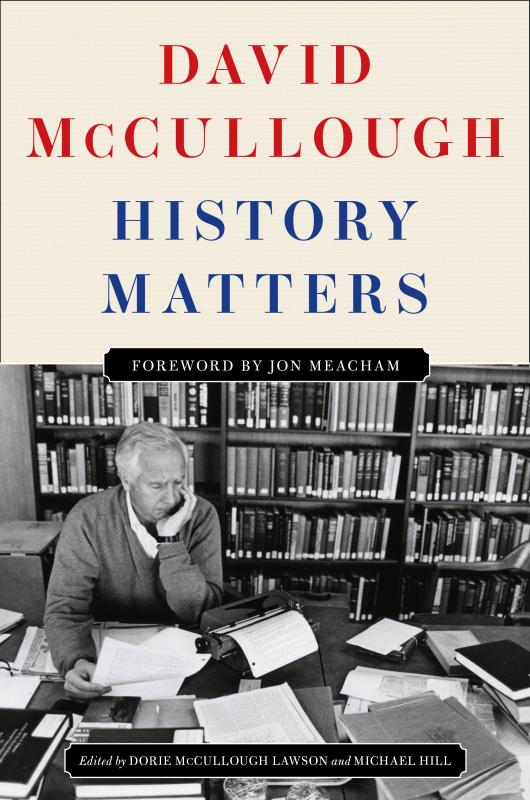
 David McCullough (Photo courtesy William McCullough)
David McCullough (Photo courtesy William McCullough)
David McCullough (Photo courtesy William McCullough)
'If we want to make it a better country, if we're serious, we would do well to begin with a few simple lessons from the past." — David McCullough, from 'The Good Work of America'
America lost a pillar of intellectual strength in 2022 when historian, author and artist David McCullough died at age 89 in Massachusetts. McCullough had lived in Camden since 2001; before that, in Martha's Vineyard, and then, years ago, in Vermont, New York City, Washington, D.C., all after he was born in Pittsburg, Pennsylvania. He was an American and at his core he represented, and advocated for, the foundational principles of his country — the rule of law, freedom of speech and representative government.
This was a man who came of age when John F. Kennedy was elected president in 1960. A president that inspired McCullough to leave New York City job at Time and moved his family to Washington, D.C., to work for the U.S. Information Agency, under Edward R. Murrow.
He was just as much a fine human being. Or, as some might say, one who lived his higher self, in a place of curiosity, kindness, artistry, generosity of spirit, sense of purpose, courage of conviction, and love for humanity and all creatures. He was, and remains, an inspirational force for contemporary times.
"Be generous," he told the Providence College Class of 2018, in a commencement address. "Give of yourselves. Count kindness as all-important in life. Take interest in those around you. Try to keep in mind that everyone you encounter along the way, no matter their background or station in life, knows something that you don't. Get in the habit of asking people about themselves, their lives, their interests, and listen to them. It is amazing what you can learn by listening."
On Sept. 16, Simon & Schuster will publish History Matters a collection of McCullough's essays, including some that were never published, or even seen. They all, according to Simon & Schuster, "address the importance of history, especially our shared history as Americans." In his lifetime, McCullough was one of the nation’s most decorated historians, winner of two Pulitzer Prizes, two National Book Awards, and the Presidential Medal of Freedom.
To the team of two who worked for several years assembling, editing and producing this new posthumous collection, McCullough was much more than a professional acquaintance. McCullough’s daughter Dorie McCullough Lawson, of Rockport, and his longtime researcher, Michael Hill, collaborated closely after McCullough's death for several years on History Matters.
The two had worked for McCullough for three decades as he researched, wrote and published his books, The Pioneers, The American Spirit, The Wright Brothers, The Greater Journey, 1776, John Adams, Truman, Brave Companions, Mornings on Horseback, The Path Between the Seas, The Great Bridge and The Johnstown Flood.
And both are authors in their own right: Lawson wrote Along Comes a Stranger, Posterity: Letters of Great Americans to Their Children. Hill, an independent historical researcher, is the author of several book, including a biography of Elihu Washburne. He also served as a historical consultant for the HBO production of David McCullough’s John Adams.
It was Lawson, one of David and Rosalee McCullough's five children, who found herself poring over countless boxes of papers left in her father's office, attic and barn after her father's death.
She discovered a treasure trove. A prolific writer and observer of human activity, there was nothing that escaped McCullough's curiosity.
"He was not just curious about the event he was researching," said Hill, in a Sept. 10 conversation with both him and Lawson. "He was endlessly curious about everything. Art, architecture, music — he loved to sing, he loved to dance — He was interested in science and technology...."
"....Birds, dogs and lyrics and Broadway," Lawson chimed in. "He approached life as a writer. We would be in the kitchen, with my mother at the refrigerator and my brother would say something. My father would say, 'oh, that's just like the scene of a play,' or, 'that would be a great opening to a novel.' He was seeing everything in terms of the structure of writing."
The quantity of papers that Lawson and Hill read over the past three years was massive — 270 feet of paper, "almost a football field," said Lawson.
At the beginning of the process, they had an idea of producing a compendium of McCullough essays, as commissioned by Simon & Schuster. By the end of 2024, the project took on a deeper meaning. U.S. society was fracturing more, and they asked themselves, what can one person do?
"This felt like something we could do," said Lawson.
"There are no more books, but there is more David McCullough and his wisdom that we could bring into the light," she said.
"Not only is the pressure of the immediacy and political circumstances of that," said Hill. "But the other was the approaching 250 anniversary of the nation's birth [the 250th anniversary of the Declaration of Independence will take place July 4, 2026]. There were these two pressures that were pushing us."
McCullough was an historian, primarily an American historian. He was also an active participant of his times, and fundamentally, he was an optimist. He was born into the Depression in 1933, was a youth in World War II, and experienced the great rebuild of Europe in the post-war years. He also was part of the surge of American optimism through the end of the 20th Century.
All the way back to the 1960s [reflected in his piece "Getting Through to Schlesinger], it was became clear to Lawson and Hill that he never veered from his essential values.
"He was the same person," said Lawson. "He held that core. Any my mother, too. They were the same people the whole time."
That included optimism and a sense of buoyancy.
"In the book he says, and it is true, he felt it — he was a short-term pessimist and a long-term optimist," said Lawson. "He would be angry or frustrated or bothered by the things that were happening at the moment. But his long-term optimism was a huge part of who he was. He believed in the people of this country so much. That we are a good people."
There was also exuberance in discovering how history shapes who we are today.
"So many pieces [in History Matters] exemplifies that joy," he said. "With all the negative vibes going on in the world these days, I hope people will take a moment and enjoy some of the pieces, enjoy his joy, his enthusiasm, his joy in being an American, his joy for books and people."
McCullough would often finish speeches or meetings with, "On we go," which, said Hill, " is optimism right there, in a phrase."
It is not to say that McCullough ignored the roughness, the cruelty, the idiocy.
In those situations, Lawson said her father would turn to a Winston Churchill quote: "We have not journeyed all this way across the centuries, across the oceans, across the mountains, across the prairies, because we are made of sugar candy." [To the Canadian House of Commons, December 30 1941]
"When things got hard, he would say that, think that, and convey that," she said.
He would encourage standing up to — and for — the right thing.
"We need courage," she said. "Courage of conviction, of honesty, inclusion and all the old verities our country is founded on. That we Americans believe and should be acting upon. Which is a better life for everybody."
David McCullough might also return to the notion of finding purpose. In his 1990 essay "The Good Work of America", which is included in History Matters, he expanded on the collective history — the "spacious realm" shared by all Americans:
"If we want to make it a better country, if we're serious, we would do well to begin with a few simple lessons from the past.
"The first is that nothing of lasting value or importance in our way of life, none of our proudest attainments, has ever come without effort. America is an effort. We are a nation born of risk and adversity — of fearful seas to cross just to get here in the first place, of land to clear, floods, epidemic disease, of slave chains and city slums and terrible winters on the high plains...
"Work got us where we are. Easy does it has never done it for us and never will."
Reach Editorial Director Lynda Clancy at lyndaclancy@penbaypilot.com; 207-706-6657