The Heartbeat of the Planet
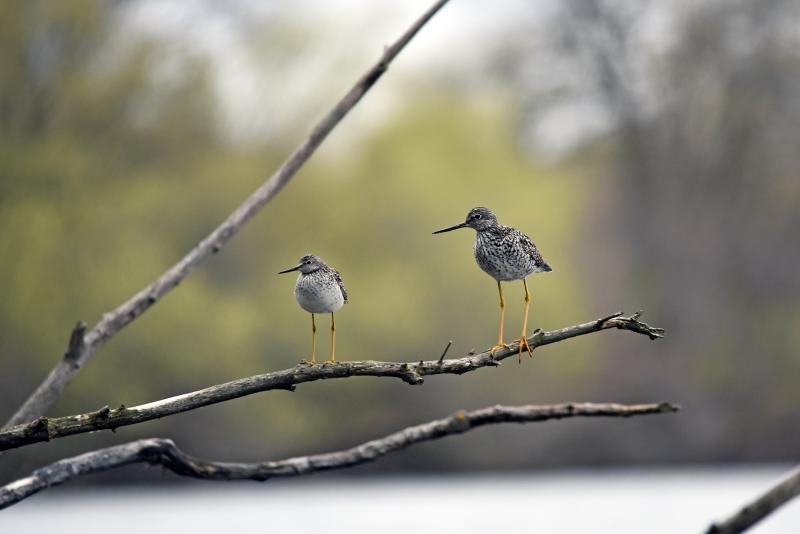 As you might expect from the name, the lesser yellowlegs (on the left in this photo) is diminutive as compared to the greater yellowlegs (on the right). Both species nest in wetlands of the Boreal Forest biome of Canada and Alaska and winter as far south as South America. Photo by Courtney Celley/USFWS, Public Domain, https://www.fws.gov/media/lesser-and-greater-yellowlegs.
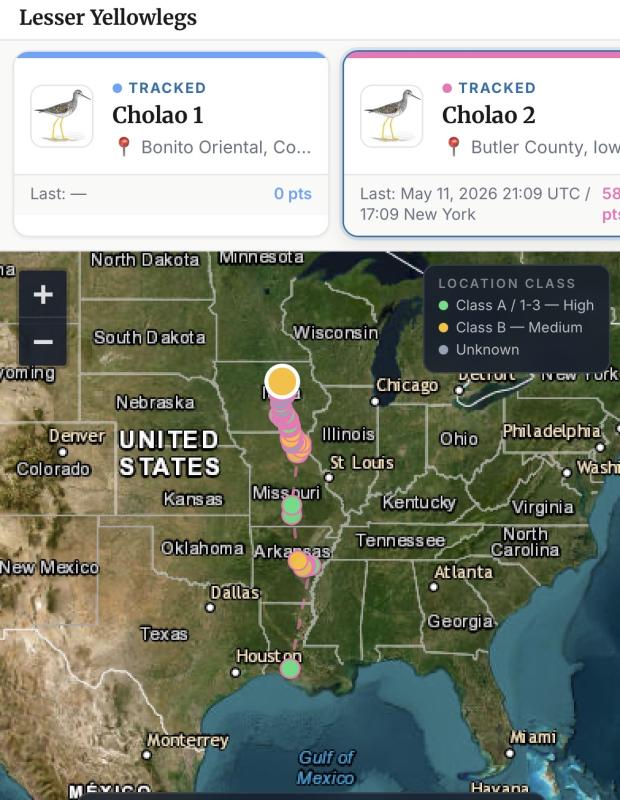 This is the migration route of Cholao 2, a lesser yellowlegs originally tagged by Audubon researchers near Cali, Colombia, that has been making its way northward across the U.S. since late April.
As you might expect from the name, the lesser yellowlegs (on the left in this photo) is diminutive as compared to the greater yellowlegs (on the right). Both species nest in wetlands of the Boreal Forest biome of Canada and Alaska and winter as far south as South America. Photo by Courtney Celley/USFWS, Public Domain, https://www.fws.gov/media/lesser-and-greater-yellowlegs.
This is the migration route of Cholao 2, a lesser yellowlegs originally tagged by Audubon researchers near Cali, Colombia, that has been making its way northward across the U.S. since late April.
This is the migration route of Cholao 2, a lesser yellowlegs originally tagged by Audubon researchers near Cali, Colombia, that has been making its way northward across the U.S. since late April.
As you might expect from the name, the lesser yellowlegs (on the left in this photo) is diminutive as compared to the greater yellowlegs (on the right). Both species nest in wetlands of the Boreal Forest biome of Canada and Alaska and winter as far south as South America. Photo by Courtney Celley/USFWS, Public Domain, https://www.fws.gov/media/lesser-and-greater-yellowlegs.
This is the migration route of Cholao 2, a lesser yellowlegs originally tagged by Audubon researchers near Cali, Colombia, that has been making its way northward across the U.S. since late April.
For us, spring birding this year has been marked by a new species arriving just about every day, making us very aware of that deep pulse of life on Earth called migration. Eastern kingbirds arrived last week, a house wren a few days ago, and today, our first prairie warblers and brown thrashers. Right in the backyard, a flock of warblers flitted through—a black-throated green singing “Zee-zee-zoo-zee” to alert us that it was there. After a few minutes of scanning the newly green maples, we’d seen black-and-white warbler, northern parula, yellow warbler, chestnut-sided warbler, and blackburnian warbler among the flock gleaning for insects in the tree’s flowers and tender leaves.
Migration was also on our mind in another way. We recently shared with you in these pages the story of the incredible journey of Cholao 2, the lesser yellowlegs that spent the winter in Colombia then traversed the Caribbean Sea in a 48-hour nonstop flight. When we last left Cholao 2’s story, it was in the ricefields and natural wetlands near White Lake in Louisiana, where it had arrived on April 26. We’ve since learned that the bird stayed in the vicinity, finding food and safety from predators, for nine days. We would love to know if it was traveling with a flock of lesser yellowlegs. We know from a scan of eBird reports that flocks of up to 200 passed through the area earlier in April and that smaller flocks were seen there into May.
On the night of May 5, Cholao 2 started trekking north again. By May 7, its satellite tag reported it near Brinkley, Arkansas. For us, that’s a town that has a great deal of significance. It’s where we stayed regularly during multiple secret trips to look for a purported ivory-billed woodpecker as part of the Cornell Lab of Ornithology’s survey teams for the thought-to-be extinct species in 2004. We won’t go into the full story of those times and the drama still surrounding the differing opinions about whether or not ivory-billed woodpeckers still live, but you can imagine how interesting it was for us to see Cholao 2 arrive near this location.
Cholao 2 had landed, after its two-day flight from Panama, near the place where the last non-migratory whooping crane had survived in Louisiana until 1950, when it was trapped and transferred to join the last remaining migratory whooping cranes that wintered on the Texas coast.
Now, just a week and half later, it has arrived at another place where ghosts of rare and extinct species floated across the landscape.
The riparian forests of Arkansas, whether or not any ivory-billed woodpeckers still existed there, had once hosted that species. When we had the honor of spending time in those forests, we saw cypress trees that were many hundreds of years old. Those massive trees certainly had once felt the feet of ivory-billed woodpeckers hitching up their trunks and maybe the resounding famous double rap of the birds’ gleaming bills. Those same trees had probably once sheltered at least the occasional now-extinct Carolina parakeet or Bachman’s warbler.
Cholao 2 spent several days in and around this special part of Arkansas, mostly finding wetlands among the farm fields that surround the forests along the creeks and rivers of the area, before moving north again on May 8. Passing south to north across Missouri, Cholao 2 arrived in Iowa late on May 8, eventually settling down by May 9 near an important wetland complex in northcentral Iowa called Big Marsh Wildlife Management Area (WMA).
Cholao has been there now for three days as we write this. Big Marsh is an area that has been restored and protected over many years through state and federal funding. Much of the land had been marginal farmland that flooded so regularly it was difficult to make it profitable for agriculture. It has been a win-win for farmers and for conservation to have parcels of the land returned to wetlands, forests, and grasslands over the years to provide migratory birds like Cholao 2 a place to feed and rest. According to eBird, at least 240 bird species have been documented here. Lesser yellowlegs are regular visitors, with peak single-day numbers reported as high as 50 from late April through mid-May. It leaves us wondering if Cholao 2 may have been there before?
We’re cheering for Cholao 2 to stay safe and healthy and travel well in this migration odyssey that billions of others birds are also undertaking across the continent.
Jeffrey V. Wells, Ph.D., is a Fellow of the Cornell Lab of Ornithology and Vice President of Boreal Conservation for National Audubon. Dr. Wells is one of the nation's leading bird experts and conservation biologists. He is a coauthor of the seminal “Birds of Maine” book and author of the “Birder’s Conservation Handbook.” His grandfather, the late John Chase, was a columnist for the Boothbay Register for many years. Allison Childs Wells, formerly of the Cornell Lab of Ornithology, is a senior director at the Natural Resources Council of Maine, a nonprofit membership organization working statewide to protect the nature of Maine. Both are widely published natural history writers and are the authors of the popular books, “Maine’s Favorite Birds” (Down East Books) and “Birds of Aruba, Bonaire, and Curaçao: A Site and Field Guide,” (Cornell University Press).