Fisherman, Island Institute project aims to reduce financial hurdles to commercial fishing electrification
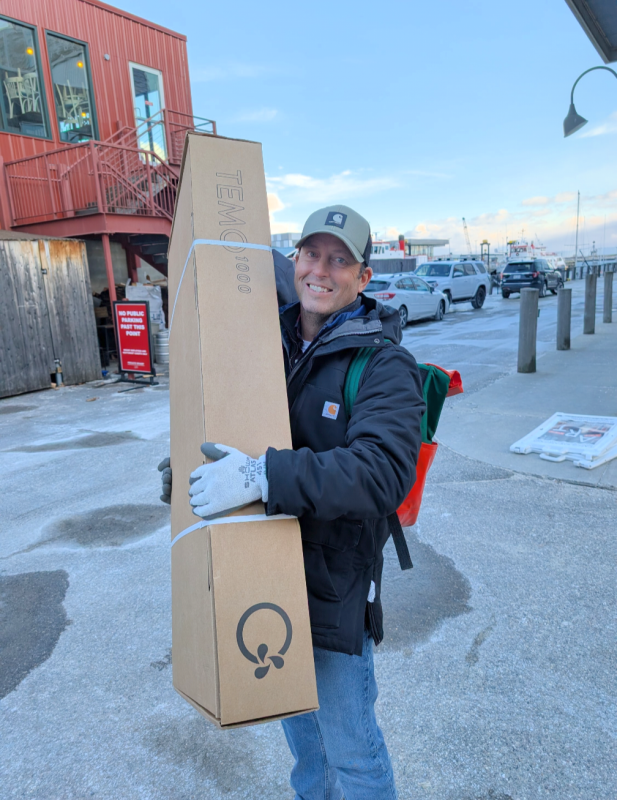 Maine kelp farmer and fisherman Nate Johnson. (Photo courtesy TEMO)
 (Photo courtesy TEMO)
Maine kelp farmer and fisherman Nate Johnson. (Photo courtesy TEMO)
(Photo courtesy TEMO)
(Photo courtesy TEMO)
Maine kelp farmer and fisherman Nate Johnson. (Photo courtesy TEMO)
(Photo courtesy TEMO)A pilot program is underway that tests the real-world operational limits of low-voltage electric propulsion in the demanding environments of New England’s working waterfront.
The project, funded and implemented by the Island Institute, centers on the installation and multi-season field testing of a TEMO·1000 electric outboard motor on an 18-foot Rosborough skiff owned by Maine kelp farmer and fisherman Nathan Johnson.
Running through November 2026, the pilot marks a critical milestone, according to TEMO, in a news release: the first systematic commercial testing of the TEMO·1000 system in water temperatures below 45°F, as well as its performance with heavy harvest loads and active fishing operations.
“This project connects directly with local innovators who are addressing both environmental and economic challenges through sustainable aquaculture,” says Nicholas Steenberg, who heads TEMO-US operations in Portland, Maine. “Nathan’s story as a seaweed farmer highlights how these efforts support Maine’s coastal communities and ocean health. It builds authentic relationships and creates visible, relatable examples that can inspire wider adoption across the marine economy.”
As part of its inaugural U.S. community outreach program, French marine tech pioneer TEMO is supporting the year-long commercial pilot program under its new TEMO In Community banner.
Why a Smaller Adoption Model Matters
According to TEMO, commercial fishing electrification has historically faced hurdles due to high equipment costs, a lack of shoreside charging infrastructure, and severe regional workforce shortages. Many New England fishermen rely on small skiffs to access larger moored vessels or conduct close-quarters tasks like menhaden (“pogie”) seining. By focusing on a highly portable, cost-effective electric outboard rather than expensive custom retrofits, TEMO and the Island Institute are creating an accessible entry point for independent mariners, especially during the winter when the risk for getting stranded is much higher.
“Safety can’t be compromised when working on the water in Maine in winter,” said Johnson. “You really need an alternative propulsion source you can count to get home for peace of mind. If you get stuck, it’s possible there could be no one on the water for miles.”
Rigorous Multi-Season Data Collection
Over the 12-month timeline, Johnson will log operating hours to do document performance in various sea and weather-conditions as well as aquaculture and fishing activities. The project gathers both quantitative and qualitative data across four seasonal phases:
• Winter Range & Cold Testing: Validating the motor’s ability to safely return to port from the kelp farm—a one-mile transit—in freezing air temperatures, intense wind, and adverse tidal states.
• Spring Harvest Maneuverability: Assessing thrust and position-holding efficiency when maximum biomass weight is suspended from the kelp lines.
• Summer Seining: Testing the viability of electric propulsion to assist with safe operation and net handling during all activities (such as fast-paced pogie fishing).
• Autumn Seeding: Evaluating precision handling to maintain strict separation of new kelp lines during long line seeding activities.
A Broad-Scale Conversion Campaign
To scale the impact of this demonstration, project data will be shared through peer-to-peer networking, regional community newsletters, and an ongoing multi-year documentary video chronicling New England kelp farming.
For technical updates or further information about TEMO and all its products, go to https://www.temo-usa.com.
About Shearwater Ventures
Shearwater Ventures, LLC is a pioneering kelp farming operation founded in 2015 by Nathan Johnson. Based in Long Island, Maine, it is one of the earliest movers in the New England seaweed aquaculture industry and operates across multiple sites in Casco Bay. For more information reach out to shearwaterventures@gmail.com.
About Island Institute
Founded in 1983 and based in Rockland, Island Institute is a community development nonprofit that boldly navigates climate and economic change with island and coastal communities to expand opportunities and deliver solutions. For more information, visit islandinstitute.org.
About “TEMO in the Community”
At TEMO, we believe sailing offers a liberating way of life that fosters well-being and a deep connection to our waters. Launching in June 2026, TEMO In The Community brings this passion to the United States, starting in the historic coastal waters of New England. We partner with vital community anchors—including grassroots sailing programs like Sail Maine and community- development organizations like the Island Institute—to expand access to the water and support sustainable coastal economies. By investing in maritime education and environmental stewardship, we aim to help preserve New England's rich boating heritage by supporting maritime education across New England through local sailing programs and marine conservation initiatives.