
Circulation, snow removal, other concerns addressed prior to postponement of full site plan application review for proposed ferry terminal parking level
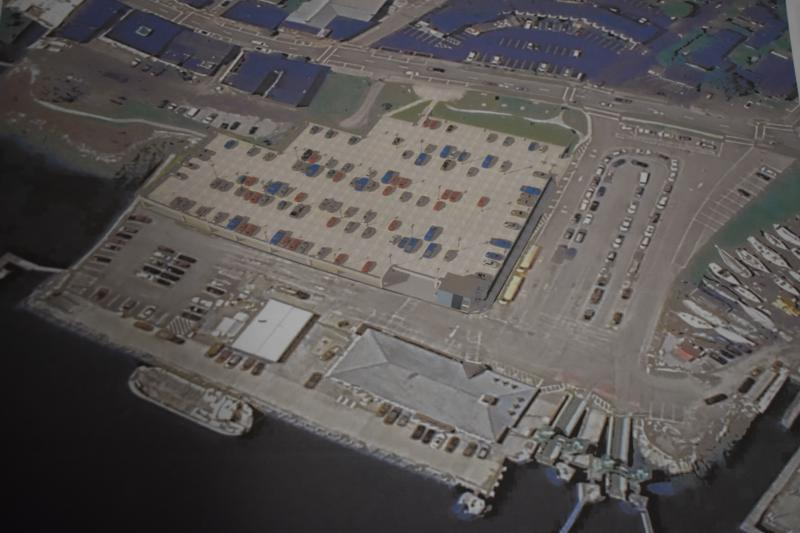 A simulated aerial view of the project, as proposed by the Maine DOT.
A simulated aerial view of the project, as proposed by the Maine DOT.
A simulated aerial view of the project, as proposed by the Maine DOT.ROCKLAND — Rockland Planning Board members approved a motion to postpone, for up to one year, the full review of a site plan application proposal that would construct a second level of parking at the ferry terminal in Rockland. The representatives of Trillium Engineering and Maine Dept. of Transportation who attended the Jan. 6, 2026 preliminary meeting viewed the meeting as just that: preliminary; the current application doesn’t expire for a full year.
As project managers work to piece together a final proposal that meets the needs of everyone impacted, as well as fits within City ordinance, MDOT continues to seek funding to cover the estimated $10 – 12.5 million construction cost. When asked why only one level would be added, versus two or three, the response came down to need versus cost. To go another level would cost another $5-7 million. MDOT is currently looking for funding for the construction phase of this proposal. State funds have been used for the design phase.
Three members of the Planning Board were in attendance for the meeting, allowing for a quorum. To help them through the process, Elias Kann, City Planner, listed key issues for them to look at: internal traffic circulation, both within the structure and within the lot; drainage; lighting; and shifts or changes in traffic patterns along Main Street or Talbot Avenue. Drainage and lighting were addressed as being the same as what is currently in place, with drainage from the second level flowing into the same catch basins already established.
On a related note regarding snow removal of the upper level, Eric Dube, of Trillium Engineering, spoke of removable rails to cut the snow off and do the removal process when it becomes convenient. The snow may have to stack it up in corners at some point. And instead of a huge plow truck, it might be a bobcat with a blade or something like that.
“The good thing about this is – I hate to say – this is going to be utilized more in the summer than in the winter,” said Dube, of Trillium Engineering. “For obvious reasons: the islands people use the islands more, and they tend to be summer communities. I’m not saying that people won’t use them. I’m not saying the DOT won’t maintain them at all. I’m just saying it will be easier maintenance wise.”
Previous public comments suggested adding solar panels. However, any solar panel placement would be a future project, according to the MDOT representative. There’s a lot of design that would be required, other structures required, other code that would need to be met.
If traffic is going to be two-way coming off the upper deck, one might want to consider how that effects incoming traffic at loading time, said one meeting attendee. As well as the shape and width of that curb cut coming in and out. Congestion within the property is another concern. Currently traffic sometimes stops when loading is occurring.
“I don’t think we’ve fleshed all of that out, fully, yet,” said the MDOT representative.
If people wanted to leave the parking area while ferries are in the process of loading, they would be able to do so by turning left. However, if they wanted to go down toward the terminal building during those times, they wouldn’t be able to do so.
As for pedestrian safety, signage will be important, particularly around crosswalk. Kann questioned the angle of the crosswalk.
“Is that the safest configuration, to have that long crossing distance at an angle, coming off the corner there, towards the ferry terminal?” he said. “Is there a safer configuration? If you have a direct crossing, you’re coming behind the blind corner, which is problematic. But the longer crossing also means you’re in the street longer.”
Dube said that the crosswalk is already established. “All we’re really doing is maintaining that crosswalk," he said.
“You want to keep in mind,” said MDOT rep. “It’s not a street, it’s a driveway, essentially. Slow traffic speeds. People pulling in and out of parking. It’s safer in that general sense.”
But then, there’s also the greater vicinity. Opposite Main Street, Talbot Avenue is directly across from the curb cut. So, in order to get to the ferry terminal, from the north.
“I imagine that most people would come up Union, and then cut down through Talbot,” said Kann. “Which allows direct access to the parking lot, across Main Street.”
For Talbot, the first 150 or so is two-way traffic, just for the hotel at the intersection. But then, it becomes one-way, going west to east toward the ferry terminal.
“So there’s potential for some traffic difficulties there, if anything changes related to that.” said Kann.
“From our perspectives, we’re not adding any ferries. Traffic isn’t changing or increasing,” said Dube.
And when a Planning Board member interjected that the circulation pattern would change a lot within the parking lot, Dube said the only circulation change expected is the two-way going back up, and that’s to alleviate the internal crossing of lanes.
When asked if a traffic study will be conducted regarding overflow parking on side streets, Dube reiterated his desire to sit down and have an actual conversation with MDOT, local police, and other members of the City.
“We could do a traffic study,” he said, “but….just putting out reports without anything tied to it – like some sort of solution or some sort of discussion – doesn’t really solve any issues. It just puts a report out to be filed. I like to actually talk about ‘OK, here’s the actual possible issues or unintended consequences and things like that, and then see if we can do stuff internally versus externally.’”
More specs:
The parking garage will be considered an accessory use, as opposed to the property's principle use, which is marine transportation facility.
The proposal is a commercial project, so it must go under review for the State Fire Marshal. And when project managers get deeper into the process, there will be shoreland restrictions that apply. These would require flood zone permits.
The City has not been able to assess proposed setbacks because the survey has not been completed.
As for timeframe: the groundwork itself is pretty extensive, and it’s not the best to do groundwork in the winter, said Dube, but traffic is lighter.
“I think a big consideration is that we are going to end up paying more money for construction to be able to do those sort of things,” he said.
See our previous article: Parking garage proposal for ferry terminal goes before Rockland Planning Board
Reach Sarah Thompson at news@penbaypilot.com