Three versions of ‘Rubber Soul’ in box set
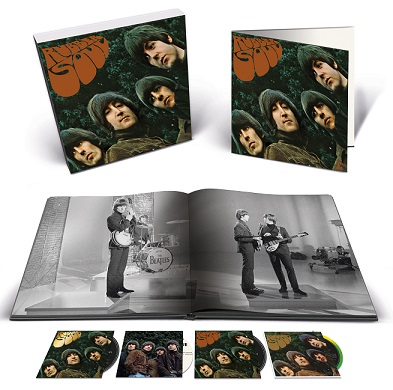 The Beatles’ “Rubber Soul” box. Apple Corps photo
The Beatles: Rubber Soul – Special Edition Super Deluxe (1965, Capitol, 4 CDs). The Beatles’ beloved 1965 album, their sixth studio album, is filled with songs about love. Fans will love this new expanded edition of the album as it features new stereo mixes by producer Giles Martin and engineer Sam Okell, alongside the original mono mix and the original Capitol U.S. album version. The second disc contains previously unreleased session recordings and home demos, as well as the contemporary single of “Day Tripper” and “We Can Work It Out.”
The late John Lennon has said that “Rubber Soul” was the first Beatles album in which the four lads from Liverpool “took over control completely.” First released on Dec. 3, 1965, the album was a pivotal moment in The Beatles' evolution. On the album, band members Lennon, Paul McCartney, George Harrison and Ringo Starr pushed beyond the conventions of pop music by embracing a more adventurous approach to songwriting and recording, including using new instruments, such as the sitar.
The album, recorded over four weeks during October and November 1965, contains the classic songs “Drive My Car,” “Norwegian Wood (This Bird Has Flown),” “Nowhere Man,” “Michelle,” “Girl” and “In My Life.” However, the songs are all memorable, the others being “You Won’t See Me,” “Think for Yourself,” “The Word,” “I’m Looking Through You,” “Wait” and “If I Needed Someone,” as well as the Ringo-sung, countryish “What Goes On” and Lennon’s non-PC “Run for Your Life.” On the album, The Beatles also experimented with new sounds and recording techniques.
The first CD contains the remixed 14-song British version of the album. Among the highlights are the tasty guitar on “Drive My Car,” Lennon’s lovely vocal on “Norwegian Wood” and the harmony vocals, some French added to the ballad “Michelle,” and more excellent vocal harmonies on the longing “Girl” and “In My Life,” the latter also with a brief classical music touch. Even Lennon’s lyrics in “Run for Your Life” are made more playful than threatening as the song is so upbeat.
With the stereo album, the remixing is more to move the sound to the center, as in the early days of stereo recording, the instruments often were pushed to different speakers.
The third CD contains the original mono album, which sounds terrific, and the fourth CD has the original U.S. version of the album, containing only 12 tracks, 10 of which appeared on the British release, plus “I’ve Just Seen a Face” and “It’s Only Love.”
The second CD is a special treat. It contains 24 early session recordings, including 20 previously unreleased takes and three previously unreleased home demos, namely “Day Tripper,” “We Can Work It Out” and “Little Girl,” the latter a previously unheard Lennon outline for a song never before released or even rumored. The band is heard talking, especially Lennon, during an early try at “Run for Your Life,” and several instrumental attempts at the track are bunched together. There are three early attempts at “Norwegian Wood,” with the second version with more of a India sound. The work take of “Day Tripper” has some laughs and again there are three backing instrumental takes. There is an excerpt of an organ solo that was tried for “In My Life,” as well as the first take of the song. Another is a very different instrumental take on “We Can Work It Out.” There are different guitars on the first take of “I’m Looking Through You” and a wilder vocal ending.
One specific example is “I’m Looking Through You (Second Version - Take 3).”Three different versions of the song were attempted on Oct. 24, Nov. 6 and finally on Nov. 10 and 11. This version comes from Nov. 6 and shows how both the tempo and arrangement had changed from the early version, while still including two instrumental 12-bar sections. McCartney subsequently wrote a bridge to replace these sections in the final version.
There also is 7:43 of The Beatles talking while recording vocal overdubs for “Think for Yourself.”
The Super Deluxe edition comes with an 88-page hardbound book that features a new introduction by Paul McCartney, and a foreword compiled from John Lennon’s own words that brings together reflections on “Rubber Soul” from across his life, including the years following The Beatles’ break-up. There also rare photographs, an in-depth album background and detailed track notes for each song. Grade: A+
AC/DC: The Bon Scott Years (2005, Shoreline Entertainment, Blu-Ray, NR, 76 min.). This column covers four more of Shoreline’s Vintage Classic Rock Docu-Series, two each on AC/DC and Aerosmith.
AC/DC is an Australian rock band formed in Sydney in 1973. Their management moved them to England after their first two albums were released only in Australia, and they became a formative influence on the new wave of British heavy metal bands, such as Def Leppard and Saxon.
This documentary follows the band through 1980, when the band’s singer Bon Scott died of alcohol poisoning. AC/DC was founded by brothers Angus (lead guitar) and Malcolm Young (rhythm guitar) with three others. After several line-up changes, they released their Australia-only debut album, “High Voltage” in 1975. Their lineup stabilized after the release of 1977’s “Let There Be Rock,” with the Young brothers joined by drummer Phil Rudd, bass guitarist Cliff Williams and singer Scott, who died seven months after the release of 1979’s “Highway to Hell.”
The documentary includes discussion by Malcolm Dome of Total Rock Radio, Jakomi Mathews of Rock Sound magazine, Tank Montana, a radio DJ and writer for Kerrang! Magazine, and others. Chris George, who has the Angus role in a cover band, demonstrates chords on his guitar throughout.
Angus was only 15 when he joined the band and he would go to practice right after school, still wearing his school uniform, which became the way he appeared on stage – plus a bundle of energy with him constantly moving while playing.
I saw the band on its first American tour Sept. 14, 1978 at the B’Ginnings nightclub in Schaumberg, Illinois, a nightclub owned by Danny Seraphine, the drummer for the band Chicago. With its low ceiling and limited space, my ears rang for three days afterwards. The band was touring in support of the “Powerage” album and performed 10 songs, concluding with “Let There Be Rock.”
Interestingly, Scott originally was a roadie for the band and even played drums, but he said he could sing better than original singer Dave Evans and won the job. The usually bare-chested Scott wrote a lot of the lyrics, sometimes a bit sleazy, but always with humor. His singing style was sneering, often half-talking/half-singing.
Among the songs heard here, at least in part, are “Highway To Hell,” “Show Business,” “Baby Please Don’t Go,” “High Voltage,” “The Jack” (about venereal disease), “T.N.T.,” “Problem Child,” “Dirty Deeds Done Dirt Cheap,” “Big Balls,” “Let There Be Rock,” “Hell Ain’t a Bad Place To Be,” “Whole Lotta Rosie,” “Rock ‘n’ Roll Damnation” and “Girls Got Rhythm.” Grade: A
AC/DC: Back in Black (2007, Shoreline Entertainment, Blu-Ray, NR, 55 min.). After Bon Scott’s 1980 death (see above), AC/DC recruited Britisher Brian Johnson to replace him. Johnson is more of a rock ‘n’ roll screamer, such as Ian Gillan of Deep Purple. Much of the same journalists who appeared on the above Blu-ray also are here as they discuss the tracks on the “Back in Black” classic album that featured Johnson as the singer.
Samples from the song are played by guitarist Simon Davies of the cover band Dirty DC. Tony Platt, the sound engineer on “Back in Black” is interviewed. Among the live videos shown are “What Do You Do for the Money Honey” and “You Shook Me All Night Long” from Japan and “Rock ‘n’ Roll Noise Pollution” from MTV. Grade: A-
Aerosmith: Live on Air (U.K., 2007, Shoreline Entertainment, Blu-Ray, NR, 100 min.). Nothing but live performances here, with 17 from the 1994 HBO broadcast of Aerosmith headlining the Woodstock ’94 festival. There is lots of energy by lead singer Steven Tyler – open shirt and sometimes shirtless – and even guitarist Joe Perry, usually shirtless.
Songs include “Eat the Rich,” “Janie’s Got a Gun” (which won Aerosmith its first Grammy), “Toys in the Attic,” “Dream On,” “Crazy,” “Sweet Emotion,” “Livin’ on the Edge,” “Dude (Looks Like a Lady)” and “Walk This Way.” Perry sings “Stop Messin’ ‘Round” and “Walk on Down.”
Other than Woodstock, the band covers The Beatles’ “Come Together” at the 1991 Grammy Awards and “Monkey on My Back” and “Janie’s Got a Gun” are from “Saturday Night Live” in 1990. Grade: A+
Aerosmith: Masterpieces – The Unauthorized Critical Review (U.K., 2008, Shoreline Entertainment, Blu-Ray, NR, 64 min.). While the above Blu-ray was nothing but live performances, this is the critical documentary, looking at the history and music of the “bad boys from Boston,” whom I have seen live in Portland, Maine. Only small portions of songs are included here, hence a lower grade. Most of those portions, in fact, are taken from the Woodstock ’94 show, which you can see complete on the other Blu-ray.
Among those discussing the songs are Malcolm Dome of Total Rock Radio, Steve Beebee of Kerrang! Magazine, Ian Fortman of Classic Rock magazine, Geoff Barton who edits Classic Rock magazine, and Paul Elliot of Mojo magazine. They discuss how drug use really affected the band while making the “Draw the Line” (1977) album and “Night in the Ruts” (1979) album, with Perry leaving midway and Brad Whitford leaving the band. The band, originally formed in Boston in 1970, reunited for the “Done with Mirrors” (1985) album and got even better with the “Permanent Vacation” (1987) and “Pump” (1989) albums, after the members got clean. Grade: A-
The Beatles’ “Rubber Soul” box. Apple Corps photo
About this blog:

My music review column, Playback, first ran in February 1972 in The Herald newspapers of Paddock Publications in Arlington Heights, IL. It moved to The Camden Herald in 1977 and to The Courier Gazette in 1978, where it was joined by my home video reviews in 1993. The columns ran on VillageSoup for awhile, but now have this new home. I worked at the Courier Gazette for 29 years, half that time as Sports Editor. Recently, I was a selectman in Owls Head for nine years.