Rockport's industrial and maritime history comes alive with new educational markers at harbor
 Camden-Rockport Historical Society President Susan Reider and Charlton Ames, president of Legacy Rockport, stand next to old caskets that were once filled with locally manufactured lime and carried to large harbors along the Eastern Seaboard to be used in making mortar and plaster in the building of American cities. (photo by Lynda Clancy)
 Rockport Town Manager Jon Duke and Legacy Rockport President Charlton Ames, Aug. 4, Rockport Harbor. (photo by Lynda Clancy)
 Heather Moran, Legacy Rockport member who lead the effort to create and erect the new historic signs at Marine Park in Rockport. (photo by Lynda Clancy)
 One the lime kilns at Rockport Harbor, standing sentry behind the Vulcan locomotive, representing the rail engines that were used to haul limestone from nearby quarries to the harbor to be burned in the kilns and manufactured into lime, which was then shipped aboard schooners for points south. (photo by Lynda Clancy)
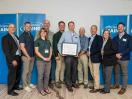
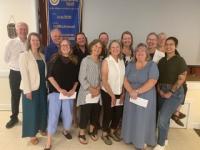
 Members of Legacy Rockport, Camden-Rockport Historical Society and Rockport municipal employees gather at the new signs at Rockport Harbor: From left to right Elizabeth Moran, Lynda Clancy, Heather Moran, Charlton Ames, Susan Reider, Denise Munger, Marci Annis, Don Rainville, Jon Duke, Alison McKellar, Mason, Abbie Leonard and Bruce Cole.
Camden-Rockport Historical Society President Susan Reider and Charlton Ames, president of Legacy Rockport, stand next to old caskets that were once filled with locally manufactured lime and carried to large harbors along the Eastern Seaboard to be used in making mortar and plaster in the building of American cities. (photo by Lynda Clancy)
Rockport Town Manager Jon Duke and Legacy Rockport President Charlton Ames, Aug. 4, Rockport Harbor. (photo by Lynda Clancy)
Heather Moran, Legacy Rockport member who lead the effort to create and erect the new historic signs at Marine Park in Rockport. (photo by Lynda Clancy)
One the lime kilns at Rockport Harbor, standing sentry behind the Vulcan locomotive, representing the rail engines that were used to haul limestone from nearby quarries to the harbor to be burned in the kilns and manufactured into lime, which was then shipped aboard schooners for points south. (photo by Lynda Clancy)
Members of Legacy Rockport, Camden-Rockport Historical Society and Rockport municipal employees gather at the new signs at Rockport Harbor: From left to right Elizabeth Moran, Lynda Clancy, Heather Moran, Charlton Ames, Susan Reider, Denise Munger, Marci Annis, Don Rainville, Jon Duke, Alison McKellar, Mason, Abbie Leonard and Bruce Cole.
Members of Legacy Rockport, Camden-Rockport Historical Society and Rockport municipal employees gather at the new signs at Rockport Harbor: From left to right Elizabeth Moran, Lynda Clancy, Heather Moran, Charlton Ames, Susan Reider, Denise Munger, Marci Annis, Don Rainville, Jon Duke, Alison McKellar, Mason, Abbie Leonard and Bruce Cole.
Camden-Rockport Historical Society President Susan Reider and Charlton Ames, president of Legacy Rockport, stand next to old caskets that were once filled with locally manufactured lime and carried to large harbors along the Eastern Seaboard to be used in making mortar and plaster in the building of American cities. (photo by Lynda Clancy)
Rockport Town Manager Jon Duke and Legacy Rockport President Charlton Ames, Aug. 4, Rockport Harbor. (photo by Lynda Clancy)
Heather Moran, Legacy Rockport member who lead the effort to create and erect the new historic signs at Marine Park in Rockport. (photo by Lynda Clancy)
One the lime kilns at Rockport Harbor, standing sentry behind the Vulcan locomotive, representing the rail engines that were used to haul limestone from nearby quarries to the harbor to be burned in the kilns and manufactured into lime, which was then shipped aboard schooners for points south. (photo by Lynda Clancy)
Members of Legacy Rockport, Camden-Rockport Historical Society and Rockport municipal employees gather at the new signs at Rockport Harbor: From left to right Elizabeth Moran, Lynda Clancy, Heather Moran, Charlton Ames, Susan Reider, Denise Munger, Marci Annis, Don Rainville, Jon Duke, Alison McKellar, Mason, Abbie Leonard and Bruce Cole. ROCKPORT — With a brief ceremony on a pleasant August 4 afternoon, the nonprofit Legacy Rockport, the Camden-Rockport Historical Society and Rockport municipal officials dedicated new outdoor historical markers near André the Seal at the town's Harbor Park, and swung the spotlight back a hundred-plus years onto local life.
"Legacy Rockport has a mission whereby we collaborate with organizations and groups that do things in Rockport for the benefit of all the citizens," said Legacy Rockport Board President Charlton Ames. "We are excited that with this particular project, we collaborated with the Historical Society."
Ames stood beside three wooden barrels, original caskets that had been used to transport lime aboard schooners bound for Boston, N.Y., Philadelphia and Washington, D.C. to be used as mortar and plaster in the country's late 19th Century construction boom. The caskets had been tied below deck with great care, given the volatile cargo and its tendency to explode into flames if water contact was made.
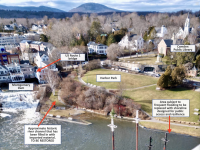
All of it had been mined from local quarries from the limestone and processed at the kilns in Rockport more than 100 years ago. Evidence of that industry can be seen at Cramer Park at the head of the harbor, the large white piles of tailings that extend above the Goose River, or at Walker Park, on the west side of the inner harbor.
Camden-Rockport Historical Society President Susan Reider stood with Ames beside the old barrels, each marked with their own explicit warnings: "Handle with care" and "Do not drop."
It was a short-lived but lucrative venture for local business owners in Camden and Rockport, and, along with shipbuilding and the fishing industry, shaped Rockport Harbor into what it is today. The new markers captured that bit of 19th and 20th Century history.
Reider credited Heather Moran, a former president of the C-R Historical Society and Legacy Rockport member, who led the initiative of the markers, "for her research and her vision to create these."
"It is just another example of how it is important to bring the past into the present, because when people from our own community and visitors look out at this beautiful harbor, they probably do not know it did not always look like this," said Reider.
During its industrial heyday, Rockport Village was smoky, filled with the din of screeching rail cars, pounding hammers, and logs being dumped into fiery kilns to keep the limestone burning night and day. The waterfront was lively as ships lay under construction, while others were loaded with great slabs of ice, cut from nearby Lily Pond. Commerce thrived on nearby streets, and small wooden houses lined Pascal Ave., and Mechanic and Sea streets.
Back then, Rockport Harbor was not the haven for summer rusticators, boat clubs and moored yachts, and the Goose River, where it empties into the salt water, was not the wildlife habitat that it has since — on its own and very quietly — restored itself to be.
"We should all remember that we do not live in the present forever," said Reider. "Some day, it is not going to look like this, either."
Over the years, numerous artifacts have been donated to the Camden-Rockport Historical Society, she said.
"We don't have enough opportunity to display them in their context, like we have with these lime barrels," Reider said.
Ames thanked Rockport Steel for its ongoing help in the various Legacy Rockport projects, including the restoration of the Vulcan locomotive, also at Marine Park, and the new historic signs.
"The work they put into the Vulcan was stunning," said Ames. "It was literally falling apart."
He also thanked Rockport Marine, in particular, its owner Taylor Allen, "who got us going," on the Vulcan restoration project. And, Ames cited the 2018 restoration project of the statue of Andre the Seal, during which the community turned out to help with the costs.
Rockport Harbor Master Abbie Leonard said harbor visitors are curious about the area and drawn to the new signs.
"I have seen lots of people, especially when we get tour buses that come in from the cruise ships, gathering and waiting to read them," she said.
The signs, plus the history of André, the Vulcan, and the lime kilns, "tie in the visitor experience."
For Moran, the marker project was a natural extension from the Mount Battie, Camden, historic sign project that Moran helped to construct.
"I had been going to Mount Battie to help light the star from Thanksgiving to New Year's," said Moran. "Every time I was there, people would ask, what's the deal with the tower [the large World War I memorial]? So I'd have to explain, over and over again. Finally, I said, 'You know what? It would be really great if we had some signage.'"
As with Rockport's project, she enlisted the help of Rockport Steel and Adventure Advertising to create historical markers at the Mt. Battie summit.
"It was an transition to follow that template and craft something for the park down here," she said. "Like Susan said, you want to be mindful of the visitor experience and interest people in history as much as you can. And, you have to meet them where they are. When I was thinking about what topics to touch on, obviously the industrial heritage of Rockport Harbor was important."
She glanced around at the immediate shoreline, adding: "And visitors don't realize that this was smoky and dusty and pretty gross."
The goal, she said, was to draw attention to the people, "who lived here and the people who worked here, and make sure we honor those stories."
She credited past historians John Lymburner Locke, Reuel Robinson, Jack Williams, and Barbara Dyer, "because it was their historical data that I pulled from and was able to do these signs."
"Rockport was just a force in crafting the number of schooners that sailed out of here," said Moran. "They didn't win the race with Camden to build the first six-masted schooner, but they came close. I think they built more ships here than they did in Camden. So it kind of evens out."
Moran thanked Adventure Advertising, for its help: "especially Amanda Pryor, who sat with me for a couple years of different iterations and changes, and she was so patient. So I'm thankful to her and the team there, and of course, Rockport Steel, and Legacy Rockport, who provided the funding and the support and moral support. It is a team effort."
Town Manager Jon Duke expressed his appreciation for the markers.
"You can learn in a very quick time, thanks to efforts like this and the Vulcan and the work with these lime kilns, who we are, where we came from, why we are, where we are," said Duke. "Where we've come in 120, 130 some odd years is pretty remarkable."
He added: "These are the things that you wish town governments could do to, but we're just not very good at it. And it takes people who have a special passion and love for where they are and where they come from, to make things like that happen."
Legacy Rockport continues its work on historic signs for other parts of town, as well as a variety of different projects. Its mission is to invest in assets that enhance the quality of life for Rockport residents and visitors. The organization emphasizes Rockport’s abundance of cultural assets, its vibrant community and natural beauty.
Reach Editorial Director Lynda Clancy at lyndaclancy@penbaypilot.com; 207-706-6657