Kansas: Stories told well in Buster's Saloon
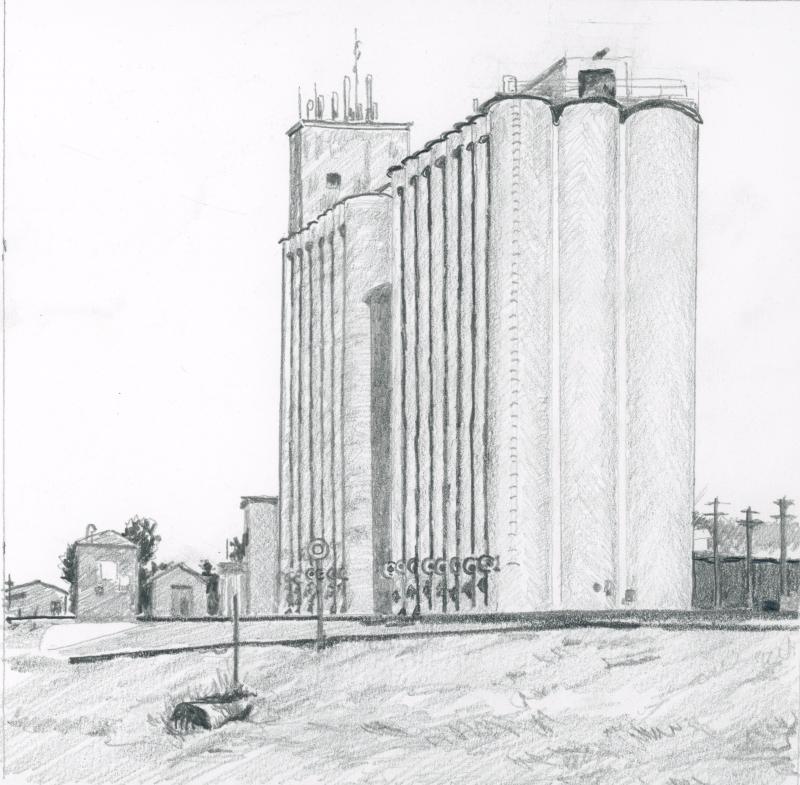 Grain elevators, Lowell, Kansas (Drawing by Rick Cronin)
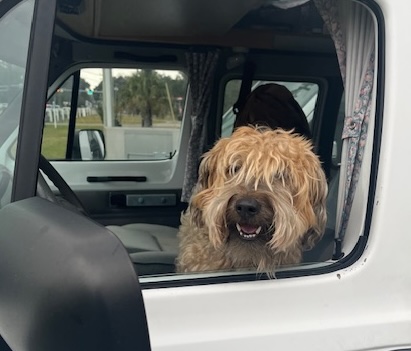 Dolly (Photo courtesy Rick Cronin)
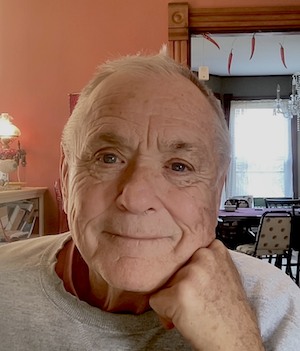 Rick Cronin, a Belfast artist, began exploring Waldo County with his sketchpad in 2024, finding the mystery and peace of the landscape, and drawing it. Then last summer, he thought: Why not broaden his horizons, explore the U.S. and sketch what captured his attention on the road? So, he bought a 1997 Dodge Roadtrek camper, and he and his wife, Susan, agreed that their shaggy dog, Dolly, would be up for the adventure. Right now, Rick and Dolly are traveling the highways of America and sending back their observations and sketches for us all to read. Those interested in receiving the full set of drawings of each state, email croninme47@gmail.com.
Grain elevators, Lowell, Kansas (Drawing by Rick Cronin)
Dolly (Photo courtesy Rick Cronin)
Rick Cronin, a Belfast artist, began exploring Waldo County with his sketchpad in 2024, finding the mystery and peace of the landscape, and drawing it. Then last summer, he thought: Why not broaden his horizons, explore the U.S. and sketch what captured his attention on the road? So, he bought a 1997 Dodge Roadtrek camper, and he and his wife, Susan, agreed that their shaggy dog, Dolly, would be up for the adventure. Right now, Rick and Dolly are traveling the highways of America and sending back their observations and sketches for us all to read. Those interested in receiving the full set of drawings of each state, email croninme47@gmail.com.
Rick Cronin, a Belfast artist, began exploring Waldo County with his sketchpad in 2024, finding the mystery and peace of the landscape, and drawing it. Then last summer, he thought: Why not broaden his horizons, explore the U.S. and sketch what captured his attention on the road? So, he bought a 1997 Dodge Roadtrek camper, and he and his wife, Susan, agreed that their shaggy dog, Dolly, would be up for the adventure. Right now, Rick and Dolly are traveling the highways of America and sending back their observations and sketches for us all to read. Those interested in receiving the full set of drawings of each state, email croninme47@gmail.com.
Grain elevators, Lowell, Kansas (Drawing by Rick Cronin)
Dolly (Photo courtesy Rick Cronin)
Rick Cronin, a Belfast artist, began exploring Waldo County with his sketchpad in 2024, finding the mystery and peace of the landscape, and drawing it. Then last summer, he thought: Why not broaden his horizons, explore the U.S. and sketch what captured his attention on the road? So, he bought a 1997 Dodge Roadtrek camper, and he and his wife, Susan, agreed that their shaggy dog, Dolly, would be up for the adventure. Right now, Rick and Dolly are traveling the highways of America and sending back their observations and sketches for us all to read. Those interested in receiving the full set of drawings of each state, email croninme47@gmail.com.A common sight after leaving New England is grain storage.
In Kansas, grain elevators can be monumental. The pyramids have nothing on some of these structures. Grain storage comes in all sizes and shapes with different uses.
It took me a while to figure out what the giant white plastic slugs stretched out in cornfields were. They’re called silage bags and are where moist freshly cut corn stalks are stored without oxygen to ferment for cow fodder. There are the fat silver rocket shaped silos of all sizes holding different grains to mix for animal feed.
The wheat fields here were just turning green in March. It was a welcome color after a winter of driving through browns, grays, ochres, and golds. I also saw my first feed lots — death row for cows.
To save myself from having to figure out what to buy everyone for Christmas every year I’ve been baking bread for some of my friends and family. They get a loaf every month. I love bread and I like baking it, so I have a reverence for these massive monuments to our daily bread.
I like a good hamburger, too, but I felt like looking away when I passed a feedlot. I know where burgers come from.
My friend, George, in New Mexico told me the best hamburger in the world could be had at Buster’s Saloon in Sun City, Kansas.Sun City is in the Gyp Hills. It has a mine that produces the gypsum for the Gold Bond brand of sheet rock.
The area is somewhat physically unique in Kansas, more like New Mexico: hills, buttes, red canyons, and outcroppings of white gypsum. There’s water flowing here and wells that never go dry.
Sun City was a great little town. It’s the first town I’ve been to that had horse turds in the street. A friendly little mutt greeted me and took me into the bar. The barkeep was picking up a finished plate of ribs and threw the bones out on the porch for the pup. Maybe he gets a kickback for every customer he brings in or maybe he just gets all the bones.
I ordered a burger with a slice of onion and horseradish (which they had) and it came with potato salad. It might not have been the best burger I’ve ever had, but it was a good fresh hamburger and the potato salad was the second best I’ve ever had. Only my Mom’s is better.
The bar itself was a delight. There were a couple of TVs — one with horse racing and one with a rodeo clown competition.
The walls had collected an assortment of cowboy art that was first rate. Some beautiful pencil drawings of cowboys. Photographs of cowboys, paintings of cowboys, maps, and a few pictures of General Eisenhower were mixed in with the heads of big deer and elk. It wasn’t decor, it was an accumulation of history.
At the bar three guys were having beers and one was having a second plate of ribs. I don’t hear all that well so sometimes I get to make up parts of the stories I’m eavesdropping on; but, I’m pretty sure I’ve got the important details straight here.
One of these cowboys was with a friend south of the state line in Oklahoma. They were drunk, in separate pickups, but decidedthey were okay to drive the back roads home to Kansas — a little two-pickup drunken caravan. If there were any problems they could help each other out. But, as luck would have it, just as they approached the state line both got stopped, by different state cops. One spent the night in jail in Oklahoma and the other slept it off in a Kansas jail. It was a good bar story and told well in a great bar.
I ended up spending two nights in the nearby Medicine Lodge City Park just so I could go back to Buster's for more of that potato salad and the second time I had the ribs. Dolly made friends with the little greeter pup, who kindly shared a bone. All dogs should have the run of some little town like Sun City.
The city park in Medicine Lodge had free camping. The town provided a free RV waste dump, and the people were friendly. I got up early after my second night and went to the 24-hour laundry to clean up a bit. It was next door to a grocery and I picked up some things while my wash was tumbling — two bananas, a jug of limeade, 10 cans of dog food, and some donut holes. When I got to the register I asked if they sold hot coffee.They didn’t, but the cashier went back into the break room and brought me a cup of their's.
In Medicine Lodge, I had been sleeping on land that five tribes of Plains Indians had camped on to meet with the U.S. Government Officials who were trying to move them to reservations, to take their land, and make them settle down like white men.
When I came to Kansas I only knew of two American heroes from Kansas: Dwight Eisenhower and Dorothy Gale. I’m adding Santanta, the Kiowa Chief, and Ten Bears, the Comanche Chief, to that list. Their explanation and defense of their culture in the face of European and American aggression was moving and eloquent, but doomed.
Santanta and Dorothy Gale had the same take on Kansas, “There’s no place like home.”
There are monumental grain elevators holding wheat. There are still authentic cowboy bars. And there are good hearted people with generous dogs. All in spite of history.
The high school’s sports teams are The Indians. It says so on the ball fields next to where I slept at night.