Audacity CAT approaches one-year commitment to weekly protests in Rockland
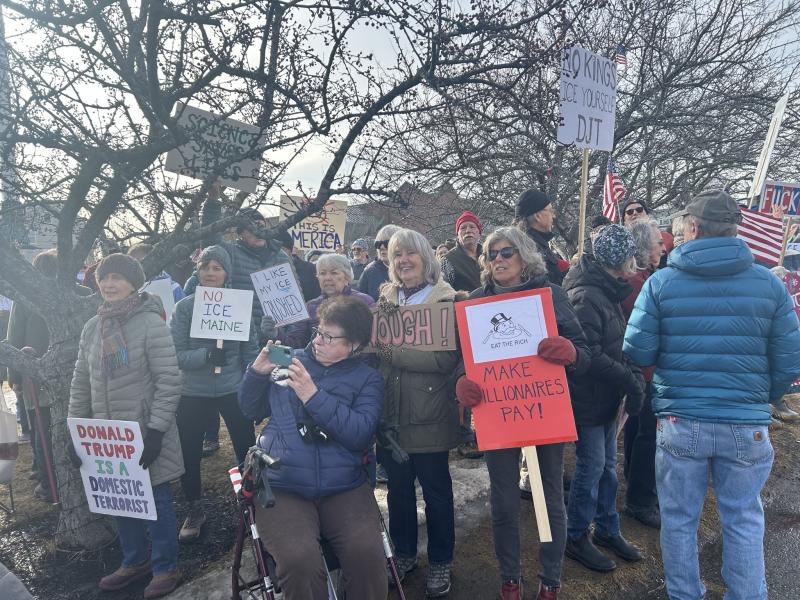 Protesters in Rockland (Photo courtesy Greg Marley)
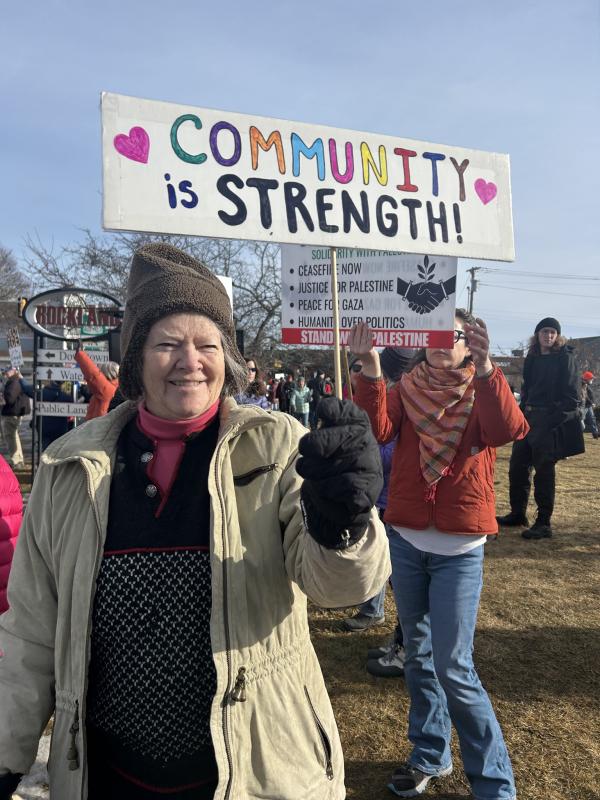 Photo courtesy Greg Marley
 Photo courtesy Greg Marley
 Photo courtesy Greg Marley
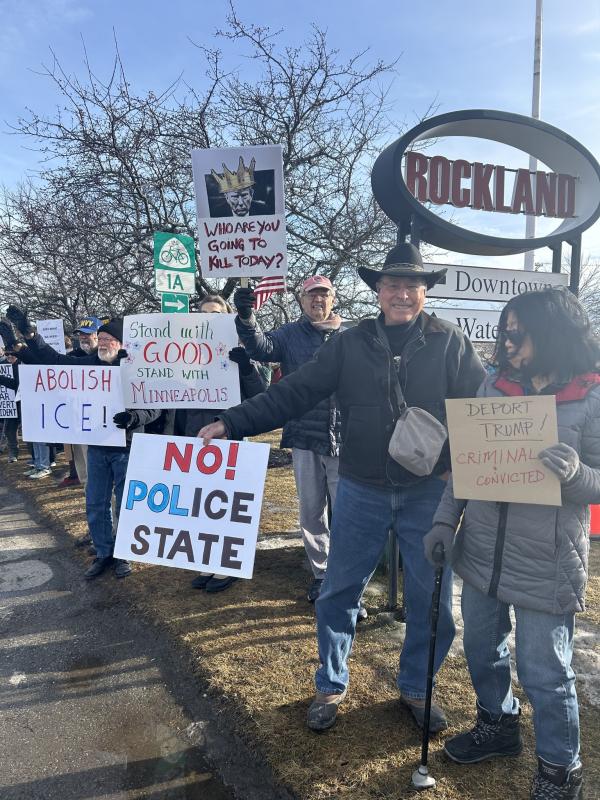 Photo courtesy Greg Marley
 Photo courtesy Greg Marley
 Photo courtesy Greg Marley
Protesters in Rockland (Photo courtesy Greg Marley)
Photo courtesy Greg Marley
Photo courtesy Greg Marley
Photo courtesy Greg Marley
Photo courtesy Greg Marley
Photo courtesy Greg Marley
Photo courtesy Greg Marley
Photo courtesy Greg Marley
Protesters in Rockland (Photo courtesy Greg Marley)
Photo courtesy Greg Marley
Photo courtesy Greg Marley
Photo courtesy Greg Marley
Photo courtesy Greg Marley
Photo courtesy Greg Marley
Photo courtesy Greg MarleyROCKLAND — It's closing in on one year since a group of Midcoast citizens started standing at Chapman Park in Rockland every Saturday from noon until 1 p.m. to protest the current U.S. presidential administration's policies and actions.
What started off as a local, grassroots group founded by community member James Cook has mobilized into a cohesive organization called The Audacity: CAT.
While it is apparent from their signs that the protesters are against policies of the Trump Administration, many might be surprised to know that when the group originated in January 2025, it consisted of Republicans, Democrats, and politically independent voters, said Peter Jenks, an organizer of, and spokesperson for, the group. Thus, they named themselves for their willingness, despite their differences, to take creative action together (CAT).
Although the protesters hold different views on specific issues, they agree on seven core values: They oppose authoritarianism, bigotry, and corruption. They support inclusive democracy, equity, and freedom. And, they are committed to nonviolence in their actions.
Jenks said the protests include approximately 100 to 200 people a week, drawing Midcoast residents in a region stretching from Bristol to Belfast.
"We originally started meeting after Trump's election at the Rockland Public Library," he said. "It wasn't just a Democratic thing; people of all political sides were frustrated."
L. Miles, another activist and demonstrator with The Audacity: CAT moved with his partner to Rockland last June.
"I would see the group on the corner and started to regularly go every weekend," he said. "We've both been pretty involved in political activism since the 2018 midterms and organizing for the Democratic party. From what I know as a historian of industrial and social change, as a concerned citizen, and also, as a member of a marginalized community, I had to go into the public square to peacefully demonstrate."
Peaceful protest with signage is the most visible part of their mission. Another part of their mission is to organize and deliver citizen testimony on multiple policies and bills at the Maine State House and Rockland City Council, and to call on Maine’s members of Congress to hold an in-person town hall.
After a tense week of nationwide political division over the U.S. Immigration and Customs Enforcement Officer's killing of Minneapolis protestor Renee Good, protests erupted across the U.S., according to Reuters and was followed by a call for more protests from a coalition of various groups.
In Maine, dozens of anti-ICE protests were held in the larger cities Portland, Bangor, and Augusta, as well as smaller communities and islands, including Islesboro. According to ABC News, citing a Quinnipiac University poll, 53% of registered U.S. voters thought the shooting was unjustified, while 35% said it was justified and 12% had no opinion.
Jenks said that Audacity CAT group met with Congressional Representative Chellie Pingree, D-Maine, most recently on Saturday, January 10. She had attended the Rockland protest, and standing in front of approximately 300 people, said: "This was our first week back in Washington, and you all know this has been a horrible, horrible, awful week. Our hearts go out to the good people of Minnesota and to the tragic death that did not have to happen. It was a murder. We will all be here to remember Renee Good. But all of us are here to remember the good people of Minnesota who are fighting back and standing up and saying, Not in my city. Get out of our f---- town and don't come back."
Meanwhile, across the country, the number of protests were surging and the level of violence rising. The news of ICE action in Maine this week raised anxiety levels across the state, with social media filling with warnings and observations.
Jenks said Audacity CAT is committed to nonviolence and has stuck to that principle.
"We're aware of how dangerous it can be," he said. "People will drive by in their pick-up trucks and give us the finger and shout things at us. We know the reality is that a truck could possibly drive into the crowd. We did a march around the block one time, and a car swerved in our direction and we had to get out of the way. And one counter-protester at the No Kings rally came up and threatened us. But we've been very fortunate that nothing has happened to us."
"We have a number of younger protesters who come out every week," he said. "And, given the demographics of Maine, it's going to be more common for white and older protestors to turn out, but out of all the people who need to stand up for others, it is us."
But, how effective are public protests in changing policy?
Numerous social media commenters have dismissed protesting as useless, while others say the result is more nuanced. A review in the journal Trends in Cognitive Sciences studied the effectiveness of nonviolent protests and concluded: "nonviolent protests seemed to be effective at increasing mobilization among sympathizers, nonnormative protests or protests involving violence seemed to be more effective at advancing policy change among more resistant target audiences."
The January 21, 2017 Women's March, for example, drew more than 500,000 protesters in Washington, D.C., with up to four million participating in affiliated demonstrations nationwide. According to The Guardian: "research confirms that the Women’s March incited tangible change. In particular, it directly prompted an unprecedented surge in female candidates for elected office."
"There has been an unbelievable gathering of people showing up every weekend in the worst kind of weather possible, so it's been an amazing determination," said Jenks.
"The thing that brings us back every single weekend is a deep commitment to our democracy, making sure we exercise our First Amendment rights," said Miles. "Our rights are only as good as we continue to practice them. My First Amendment rights include peacefully gathering, peacefully demonstrating, and I think a lot of folks forget that the First Amendment also protects the right to peacefully determine ways they want to petition their government for a redress of grievances. I have the right to say I don't like what the government is doing and have the right to mobilize with my community."
"These protests have been a profound statement on where our community stands," said Jenks. "It's so important to make a stand to say this is not acceptable and we won't put up with the current chaos in the government. When the ultra-wealthy are spending billions of dollars to convince people through media and publications that their perception is the only perception, that's when the community needs to come together and speak out. We may not have the platforms, but we do have the street corner."
Jenks said the AudacityCAT group will hold their anniversary protest Saturday, February 7 from 12 to 1 p.m. at Chapman Park.
To learn more visit their Facebook page.
Kay Stephens can be reached at news@penbaypilot.com