UMaine screens documentary highlighting UMaine’s role in national hazing prevention movement
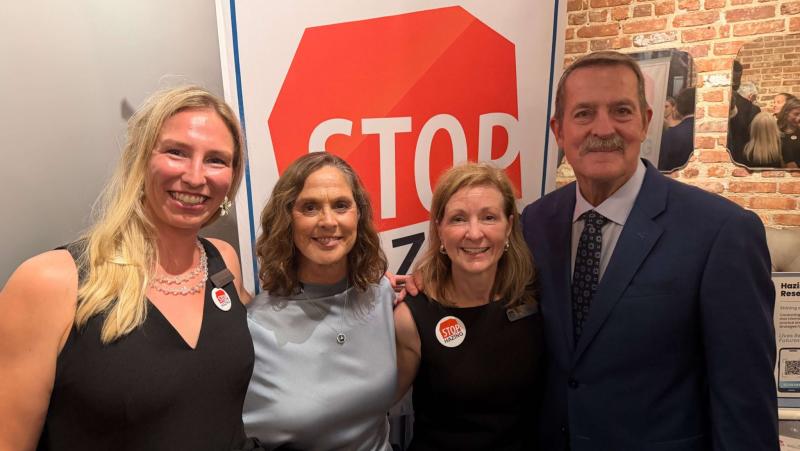 (L-R): Meredith Stewart, Julie DeVercelly, Elizabeth Allan and Gary DeVercelly attend the screening of “4000 Days” at the 2026 Tribeca Film Festival in June. (Photo courtesy Elizabeth Allan)
(L-R): Meredith Stewart, Julie DeVercelly, Elizabeth Allan and Gary DeVercelly attend the screening of “4000 Days” at the 2026 Tribeca Film Festival in June. (Photo courtesy Elizabeth Allan)
(L-R): Meredith Stewart, Julie DeVercelly, Elizabeth Allan and Gary DeVercelly attend the screening of “4000 Days” at the 2026 Tribeca Film Festival in June. (Photo courtesy Elizabeth Allan)
ORONO — Filmmaker Daniel Catullo’s work has taken him from concert stages and music videos to documentary filmmaking. But after a West Virginia University freshman died in a fraternity hazing incident in 2014, Catullo began using his work to address the harm caused by hazing.
That work eventually connected him with University of Maine professor of higher education Elizabeth Allan, whose research has helped shape the national conversation about hazing and its prevention.
Catullo’s latest film, “4000 Days,” was inspired in part by Allan’s research. UMaine will host two screenings of the film, Sept. 22 and 23, at 6 p.m., at the Donald P. Corbett Business Building.
The screenings will be held during National Hazing Awareness Week, Sept. 21-25.
“Dr. Allan and the University of Maine have set the standard for research into hazing and hazing culture,” Catullo said. “Her work has become an essential resource for so many of us working in this space, myself included.”
The feature-length documentary tells the stories of three families who lost sons to hazing as they turned their personal tragedies into a push for reform that ultimately led Congress to pass the 2024 Stop Campus Hazing Act. The bipartisan act requires colleges and universities to implement comprehensive hazing prevention programs and to increase transparency by publicly reporting hazing incidents in annual campus security reports, known as Clery Reports.
The film debuted at the Tribeca Film Festival over the summer and has since been shown at other festivals.
Allan, who directs UMaine’s Hazing Prevention Research Lab and is principal and founder of the research group StopHazing, was consulted by members of Congress and their staff while the Stop Campus Hazing Act was being written.
She co-authored the landmark 2008 study “Hazing in View: College Students at Risk," still the most comprehensive examination of hazing in higher education. She’s currently working with a team of researchers at UMaine and across the country on an updated national study.
Catullo said having the support of an expert like Allan helps validate a project like “4000 Days.”
“We hope that this partnership between our film and Dr. Allan’s groundbreaking work will help bring the issue to a much larger stage, raise awareness of how widespread and serious the problem of hazing is, and ultimately help drive meaningful change,” he said.
Allan has seen “4000 Days” a few times, including when it premiered at Tribeca, and says it adds to the national conversation about hazing prevention.
“Research can help us understand the scope, causes and the strategies that can be effective in the prevention of hazing, but stories help us understand the issue in human terms,” Allan said. “‘4000 Days’ is about the lived experiences of families whose lives have been changed forever by hazing. It has the power to deepen public understanding, strengthen the movement for prevention, and inspire the kind of collective action needed to prevent more senseless deaths.”
Catullo attended West Virginia University, where he was a member of the Sigma Phi Epsilon fraternity. He later became a donor to the university and was inducted into WVU’s Greek Alumni Hall of Fame.
In 2014, WVU freshman Nolan Burch died from hazing as a fraternity pledge. Burch’s death led Catullo to begin directing documentaries and educational films about the harm caused by hazing. In 2019, he released his first hazing documentary, a 35-minute film about Burch’s death called “Breathe, Nolan, Breathe.”
“Nolan’s death affected me deeply. It happened at my alma mater, and it was so senseless,” Catullo said. “My own fraternity experience in college had been such a positive and meaningful part of my life, so I struggled to comprehend how something that had meant so much to me could become so dangerous — and even deadly — for others. I couldn’t just stand by. I knew I had to do something.”
Joining Allan at the UMaine screenings will be Julie and Gary DeVercelly, who served as producers of the film and whose son, Gary Jr., died in a fraternity hazing incident at Rider University in New Jersey in 2007. The DeVercellys are longtime supporters of Allan’s work.
“After Gary Jr. was killed, the first National Study of Student Hazing, released in 2008, helped us understand that his death was part of a much larger national problem,” said Julie DeVercelly.
In 2014, they invited Allan to share her expertise in a short documentary — “We Don’t Haze” — produced in partnership with the Clery Center, a national nonprofit dedicated to creating safer college campuses.
Julie DeVercelly serves on the Clery Center board of directors and says “We Don’t Haze” became an important part of their family’s journey from loss to education, advocacy and prevention.
“Research gave our loss a voice — and gave us a path forward,” she said. “Nearly 20 years later, a new national study is long overdue. The landscape has changed dramatically, and we need current data to understand hazing today so we can better protect students tomorrow.”
“The 2008 study helped inform We Don’t Haze, and our partnership with Dr. Allan and the Clery Center helped us take that message beyond education and onto Capitol Hill,” added Gary DeVercelly. “Together, we walked the halls of Congress, met with lawmakers, and advocated for the federal legislation that ultimately became the Stop Campus Hazing Act.”
Gary DeVercelly reiterates that there’s still much work to do to end hazing and that the federal legislation and the new national study of college student hazing provide an opportunity to build on the work that came before.
“Data drives everything. After nearly 20 years, we need to know what has changed, what hasn’t, and what we must do differently. This new study can help turn knowledge into meaningful prevention,” he said.
Audiences at both UMaine screenings will have opportunities to ask questions of Allan and the DeVercellys, who will be in person, and Catullo, who plans to join the Q&A’s virtually.