The Tale of the Monster Goldenrod
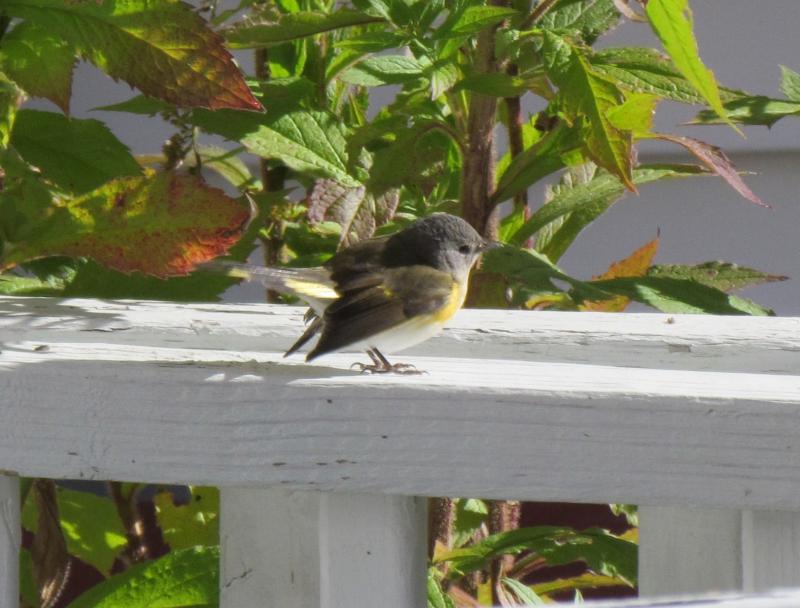 The authors were delighted when a late-for-the-season American restart joined the party at the cheery yellow plant. Courtesy of Jeff Wells
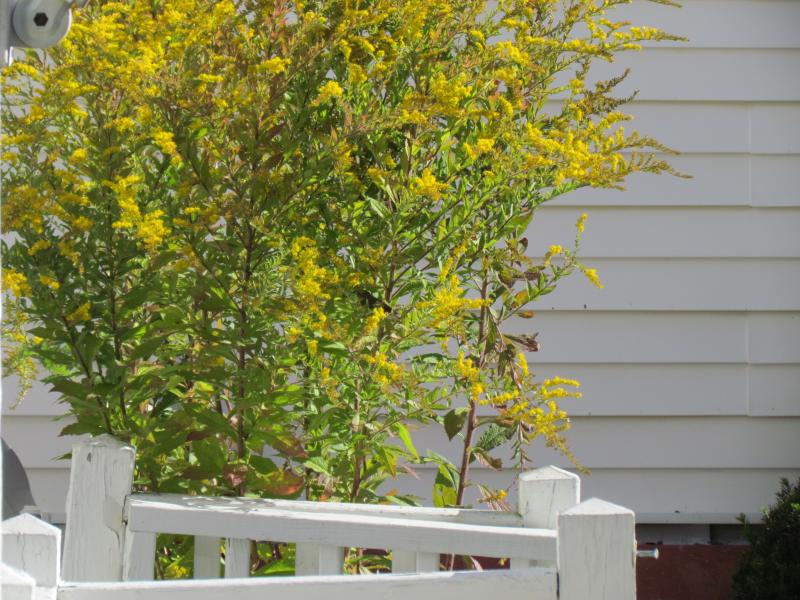 The enormous goldenrod that has attracted so much life at the authors' porch. Courtesy of Jeff Wells
The authors were delighted when a late-for-the-season American restart joined the party at the cheery yellow plant. Courtesy of Jeff Wells
The enormous goldenrod that has attracted so much life at the authors' porch. Courtesy of Jeff Wells
The enormous goldenrod that has attracted so much life at the authors' porch. Courtesy of Jeff Wells
The authors were delighted when a late-for-the-season American restart joined the party at the cheery yellow plant. Courtesy of Jeff Wells
The enormous goldenrod that has attracted so much life at the authors' porch. Courtesy of Jeff Wells
We have a six-foot-high stand of goldenrod hanging over our front porch. It was not easy to leave it there throughout the spring and summer as it grew from its modest beginnings; it partially blocks access. But when it first appeared last fall, we were curious to see what would become of it. We enjoyed the cheery yellow flowers and especially found it satisfying and interesting to document the many insects that made use of the goldenrod flowers.
Last year, the stalksreached perhaps four feet in stature but goldenrods are plants that live over many years (perennials, the gardeners will point out, is the term to describe them) and apparently, if they do well one year, they can keep getting bigger in following years.
This fall, our goldenrod (iNaturalist tells us it is a common wrinkle-leaved goldenrod) has been a beautiful sight for the eyes and a bonanza for bugs. Using the iNaturalist app to document the insects, we have found abundant honeybees, common eastern bumblebees, European paper wasps, northern paper wasps, and more. One of the more prominent insects has been the shiny emerald-colored greenbottle flies.
Other insects have shown up only once or twice. Cool ones like the locust borer we first mistook for a wasp because of its yellow and black stripes. A swift feather-legged fly, with bright orange abdomen and black wings looking very sporty, came by one day. A photo we snapped of something that looked a little odd with one of the greenbottle flies turned out to be a wonderfully named jagged ambush bug – it was sucking the life out of the fly.
And there were more.
But one of the surprises of life supported by our monster goldenrod came just this past week – and American redstart. As the fall weather cools, there are fewer and fewer warbler species still around. Many are already on their wintering grounds in South America, Central America, the Caribbean, Mexico, and the southern U.S.
There are still lots of yellow-rumped warblers around, of course. They (and palm warblers) are among the last of the warblers to migrate through our area. A few yellow-rumps even linger into winter. As climate change moderates the fall and winter temperatures, a few other warbler species have been staying later and later in the season as well.
So we weren’t completely shocked to see theredstart. It flitted around flashing the yellow spots in its tail as it actively searched for insects.
Maybe we shouldn’t have been surprised, in particular, that this bird found the monster goldenrod. There it was, hovering among the bright yellow flowers, dropping down on the porch and even on the porch table near where we like to sit. It was so fun to see this sprightly forest gem of a bird actively taking advantage of the insects that the plant that we fostered was hosting.
It is such a joy when we can see the intersections of the living world, the nis and outs of the web of life, right within our own yards. Hope you are all having a good fall!
Jeffrey V. Wells, Ph.D., is a Fellow of the Cornell Lab of Ornithology and Vice President of Boreal Conservation for National Audubon. Dr. Wells is one of the nation's leading bird experts and conservation biologists. He is a coauthor of the seminal “Birds of Maine” book and author of the “Birder’s Conservation Handbook.” His grandfather, the late John Chase, was a columnist for the Boothbay Register for many years. Allison Childs Wells, formerly of the Cornell Lab of Ornithology, is a senior director at the Natural Resources Council of Maine, a nonprofit membership organization working statewide to protect the nature of Maine. Both are widely published natural history writers and are the authors of the popular books, “Maine’s Favorite Birds” (Down East Books) and “Birds of Aruba, Bonaire, and Curaçao: A Site and Field Guide,” (Cornell University Press).