
Midcoast remains in a Severe Drought: Mainers encouraged to conserve water, report dry wells
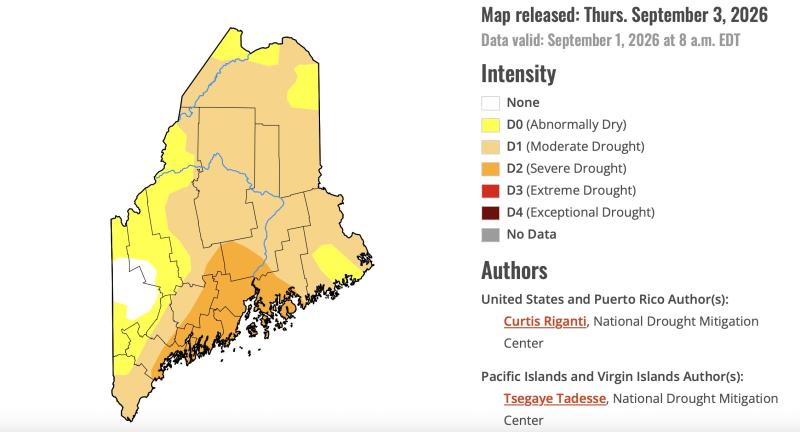 The U.S. Drought Monitor is jointly produced by the National Drought Mitigation Center at the University of Nebraska-Lincoln, the United States Department of Agriculture, the National Oceanic and Atmospheric Administration and the National Aeronautics and Space Administration. Map courtesy of NDMC.
The U.S. Drought Monitor is jointly produced by the National Drought Mitigation Center at the University of Nebraska-Lincoln, the United States Department of Agriculture, the National Oceanic and Atmospheric Administration and the National Aeronautics and Space Administration. Map courtesy of NDMC.
The U.S. Drought Monitor is jointly produced by the National Drought Mitigation Center at the University of Nebraska-Lincoln, the United States Department of Agriculture, the National Oceanic and Atmospheric Administration and the National Aeronautics and Space Administration. Map courtesy of NDMC.Maine’s Drought Task Force convened September 3 for the first time this season to discuss drought conditions across the state. Maine continues to experience widespread dry conditions, with impacts being reported across the state’s water resources, agriculture, drinking water systems and fisheries.
The National Weather Service offices in Gray and Caribou report that after improvements this spring and early summer, drought has been on the increase across most parts of the state after another summer of below normal rainfall, according to a news release from Maine's Emergency Management Agency.
The Sept. 3 rain only brought short-term improvement, the release said.
“Maine is not immune to drought, and we are seeing the effects of prolonged dry conditions across the state,” said MEMA Director Pete Rogers, in the release. “We encourage Mainers to conserve water, monitor local conditions, and report dry wells so we can better understand where assistance may be needed.”
Groundwater levels across much of the Maine never recovered from Fall 2025’s record lows and have been below normal for roughly a year, making groundwater the state's biggest water resource concern.
The Maine Department of Health and Human Services Center for Disease Control and Prevention’s Drinking Water Program has received drought-related notifications from public water systems in York, Washington, and Hancock counties. Dry well reports are also increasing, with 40 reports across 15 counties received this season as of September 3.
Drought conditions are also affecting Maine agriculture and fisheries. Farmers should consider applying to the state's Farmers Drought Resilience Program, which funds wells, water storage ponds, and water management plans, with the next round of applications expected this fall.
Producers facing drought-related losses may also qualify for federal assistance through their local USDA Farm Service Agency office. Meanwhile, fisheries officials report groundwater-fed streams running dry, with potential impacts to Atlantic salmon and alewife populations from this year's and last year's drought.
What Mainers Should Know and Do
- Conserve water: Follow any local water-use restrictions and look for ways to reduce unnecessary water use. Find tips here.
- Check private wells: If you rely on a private well, monitor your water supply and report a dry well through the state’s dry well survey.
- Protect drinking water supplies: Public water systems experiencing drought-related impacts should notify the Maine CDC’s Drinking Water Program.
- Farmers: Monitor water availability and seek available drought assistance and resources through state agricultural programs.
- Stay informed: Conditions can vary significantly from one part of Maine to another. Follow updates from MEMA, local emergency management agencies, and other state agencies.
If assistance is required filling out the survey, Mainers can either call 211 or 1-877-463-6207, or they can text their Maine zip code to 898-211. Please note that reporting a dry well is not an application for assistance.
The Drought Task Force continues to monitor water supplies, public drinking water systems, groundwater conditions, agriculture, fisheries, and other impacts as the state moves into the fall. The date of the next Drought Task Force meeting will be forthcoming.
For more information visit:
Northeast Drought Early Warning System (NE DEWS)
Maine Forest Service Wildfire Danger Report
For other safety and preparedness information, visit MEMA’s website or find us on Facebook, X, Bluesky, and Nextdoor.