Analysis: For children with brain injuries, UMaine BEaR Lab offers support
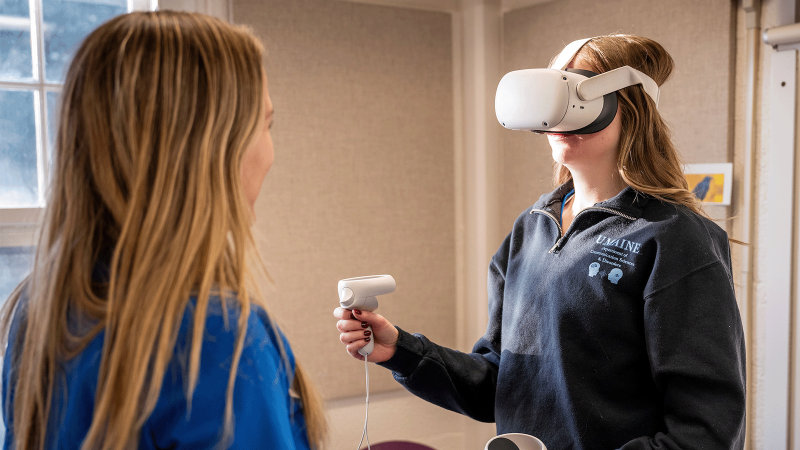 Ellie Walker (left) and Sydney Garrison (right), both graduate students in the Department of Communication Sciences and Disorders, test a VR application designed to evaluate the cognitive communication skills of children with brain injuries in the UMaine Brain Injury, Education, and Rehabilitation. (Photo courtesy University of Maine)
Ellie Walker (left) and Sydney Garrison (right), both graduate students in the Department of Communication Sciences and Disorders, test a VR application designed to evaluate the cognitive communication skills of children with brain injuries in the UMaine Brain Injury, Education, and Rehabilitation. (Photo courtesy University of Maine)
Ellie Walker (left) and Sydney Garrison (right), both graduate students in the Department of Communication Sciences and Disorders, test a VR application designed to evaluate the cognitive communication skills of children with brain injuries in the UMaine Brain Injury, Education, and Rehabilitation. (Photo courtesy University of Maine)
University of Maine researchers are helping children with traumatic brain injuries learn and excel in the world around them, addressing a critical need in pediatric care in the state.
According to the Centers for Disease Control and Prevention, more than 3,000 Maine children experience brain injuries each year, and an estimated 20% — or 600 children — experience more severe trauma. Yet only about 130 receive formal school-based support for these injuries and often they often do not get the care needed to thrive.
Jessica Riccardi, an assistant professor of communication sciences and disorders, leads the Brain Injury, Education, and Rehabilitation (BEaR) Lab at UMaine. The team advances research as they support children with acquired brain injuries by working directly with them, their families and their practitioners to improve long-term outcomes for these children. Examples of support the lab provides includes professional development for schools and community organizations, consultation with educational teams on students with brain injury, and referring families to national, state and local resources for childhood brain injury.
The team’s work is especially important in Maine, which does not have a pediatric rehabilitation hospital. The state’s only pediatric intensive care center is in Portland, limiting the availability of care options to children elsewhere in the state. Riccardi said the transition from hospital to school after traumatic brain injuries is often difficult for children, and Mainers feel the problem more intensely due to limited access to medical services for kids, particularly in rural communities. The direct work the lab does is important to improving detection and connecting children to resources.
In addition to improving long-term outcomes for children with brain injuries, Riccardi’s lab also offers graduate and undergraduate students research and hands-on experiences with clinical populations.
One of these students is Elise DeRosby, a communication sciences and disorders major from Hampden, Maine. DeRosby has been working with Riccardi for nearly two years in research that complements her interests, including working face-to-face with people.
In collaboration with UMaine’s Virtual Environment and Multimodal Interaction (VEMI) Lab, DeRosby recently helped run a project that uses virtual reality equipment to assess cognitive communication in kids with brain injuries. Cognitive communication is when cognitive skills, such as memory, attention, planning and organization, influence your communication abilities.
“Think about it in a school setting,” Riccardi said. “If they have a hard time maintaining attention, they’re going to do poorly on a test, not because they don’t know the content, but because they didn’t pay attention in the first place.”
To examine the cognitive communication of these kids, researchers put them in a virtual classroom where they had to make decisions in a simulated egg-drop science experiment.
“They have to choose a design for which model of egg carrier,” said DeRosby. “They have to go through the process of picking a design, then instructions will tell them to collect materials and they have to assemble the design, then get the egg, put it in the design and drop it off bleachers in a school gym.”
Using this virtual reality scenario, researchers can collect data on a child’s decision-making, attention and processing, all of which are components of cognitive communication. While much more data collection is necessary for this project to be useful, Riccardi and DeRosby hope that their research will help in developing resources for clinicians, particularly speech-language pathologists, to serve kids with brain injuries.
DeRosby’s research experiences in the BEaR Lab and UMaine more broadly have helped her understand what she wants to pursue in life. After originally pursuing molecular and cellular biology, DeRosby shifted to speech pathology to work more face-to-face with other people.
With funding from UMaine’s Center for Undergraduate Research, she was able to do that in the BEaR lab, studying art therapy for adults with brain injuries. Working with participants, learning about their injuries and experience and helping develop tools to help them was moving.
“I think it is an eye-opening experience to get to interact with people. You don’t get that in the classroom,” said DeRosby.
While the lab’s research is contributing to understanding childhood brain injuries, it is also helping to develop the next generation of researchers and professionals who will be working with the communities that need it most.
“Our clients often say that the person who took a moment to understand their challenges was the person who really changed their recovery,” said Riccardi. Through her lab, Riccardi hopes the students in her lab can be “that person.” Raising empathy and understanding for those with brain injuries is an important first step towards success in these individuals’ lives.
“Taking the time to understand other people’s perspectives and where they come from,” DeRosby said, “any human can learn that, and it will make us all better.”
If you are interested in learning more about the work Riccardi’s research team is doing, you can visit the BEaR Lab website, or contact Riccardi at jessica.riccardi@maine.edu.
As Maine’s only public research university and a Carnegie R1 top-tier research institution, the University of Maine advances learning and discovery through excellence and innovation. Founded in 1865 in Orono, UMaine is the state’s land, sea and space grant university with a regional campus at the University of Maine at Machias. Our students come from all over the world and work with faculty conducting fieldwork around the globe — from the North Atlantic to the Antarctic. Located on Marsh Island in the homeland of the Penobscot Nation with UMaine Machias located in the homeland of the Passamaquoddy Nation, UMaine’s statewide mission is to foster an environment that creates tomorrow’s leaders. As the state’s flagship institution, UMaine offers nearly 200 degree programs through which students can earn bachelor’s, master’s, professional master’s and doctoral degrees as well as graduate certificates. For more information about UMaine and UMaine Machias, visit umaine.edu/about/quick-facts/ and machias.edu/about-umm/umm-facts/.