
With a shortage of young striped bass, Maine anglers fear for their sport’s future
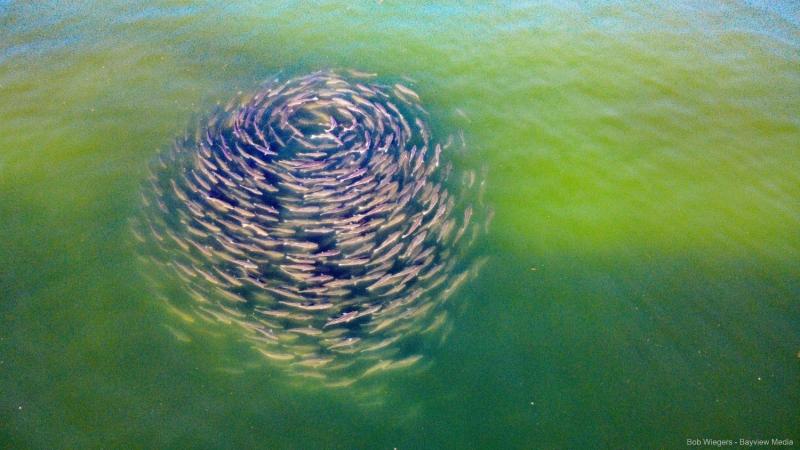 A school of striped bass in Saco Bay on Aug. 9, 2026. Photo by Bob Wiegers.
From May to October each year, hundreds of thousands of anglers fan out across the Maine coast, casting their lines from beaches, piers and boats. Most are fishing for Atlantic striped bass, affectionately called “stripers,” which make up the largest recreational saltwater fishery in the state.
For now, the fishing is good, with plenty of big stripers around to catch (and mostly, release). But a current of anxiety runs underneath the sport and the industry.
Captain Marco Lamothe, who runs Keeper Charters out of Saco, went on more than 100 fishing trips this year and caught plenty of larger, older striped bass, which can live to 30 years or more. But he worries about the fishery’s future because he’s not seeing as many smaller, younger fish.
Of the hundreds of striped bass he caught this year, only one measured less than 28 inches.
“The tourists were abundant, and the fish were cooperative, and we had a lot of really successful fishing trips,” Lamothe said. But, he added, “We’re just not seeing any small- to medium-sized fish. So it’s concerning.”
Zachary Whitener, a senior research associate at the Gulf of Maine Research Institute and a former charter boat captain himself, put it more strongly.
“It’s terrifying,” he said. “Once those big fish are gone, there’s nobody to refill the population.”
The factors behind this decline are complex, Whitener said. But one major factor is rainfall in the Chesapeake Bay watershed. Some striped bass spawn in the Kennebec River watershed here in Maine, but most stripers are born in the Chesapeake and migrate up and down the East Coast each year.
Striped bass need plenty of rain and freshwater to reproduce. As the climate is changing, so are rainfall patterns. And the Chesapeake has seen plenty of drought in recent years.
Scientists in Maryland and Virginia conduct surveys each spring for juvenile striped bass in the rivers that feed into Chesapeake Bay, to see how many young fish are born and then survive the earliest stages of life, in a process they call recruitment.
For nearly a decade, there haven’t been very many young stripers.
The latest survey from the Maryland Department of Natural Resources, released on Oct. 19, shows that striped bass recruitment was low for the eighth year in a row. Results from the Virginia Institute of Marine Science survey were better, showing average recruitment in the southern half of the bay this year. The scientists noted in their report, however, that “low recruitment in recent years remains a major concern.”
These surveys are important pieces of an ongoing stock assessment coordinated by the fishery’s regulatory body, the Atlantic States Marine Fisheries Commission.
‘Keeping fish is not helping anything’
State and federal officials estimate that anglers made nearly 1.8 million saltwater recreational fishing trips in Maine last year, catching more than 800,000 striped bass. They kept about 61,000 of those fish, or roughly 7 percent, releasing the rest.
A bustling industry has grown around the sport, from guided fishing trips on charter boats to the tackle shops and bait dealers that supply anglers.
Maine does not have a commercial striped bass fishery, though some other states do. The recreational fisheries are much larger. Recreational fishing accounts for approximately 82 percent of the striped bass caught and killed each year, according to the Atlantic States Marine Fisheries Commission. This includes the 9 percent of fish that scientists estimate die from stress after being caught and released.
Mainers who make their living from striped bass are closely watching the stock assessment and regulatory process, waiting to see what happens next.
George Norris, owner of The Tackle Shop in Falmouth, said his shop had plenty of foot traffic this summer, especially with people’s excitement over catching big fish. But he’s deeply concerned about the near future.
Although Norris believes environmental factors are harming the species more than overfishing, and though more rules might hurt business in the short term, he still wants regulators to take stronger action to protect the existing spawning population.
“They’re finding great information, but they’re not doing anything with that information,” he said.
Back in 2019, the commission declared striped bass to be overfished and set a deadline of 2029 for rebuilding the population. The last stock assessment, released in 2024, found that, while people are no longer actively overfishing striped bass, the population remains low overall.
Regulators have tried out different catch limits over the years. The current rules limit recreational fishermen to keeping one striped bass per day and only if the fish is 28 to 31 inches long. The size restriction is specifically meant to protect fish born in 2015, a strong year, allowing them to stay in the population and reproduce.
Norris advocated for a temporary moratorium on anglers keeping any fish at all and seeing if that helps.
“Keeping fish is not helping anything,” he said. “We’re just taking breeding fish out of the population.”
The commission is feeling the pressure to further restrict the fishery, said Bob Humphrey, a wildlife biologist and fishing guide who is one of two Mainers on the commission’s striped bass advisory panel. He said the commission’s goal is “to make sure that everybody can harvest as much as they possibly can without harming the population.”
Maine gets the short end of the stick, Humphrey added. Being at the end of the striped bass migration route means Maine’s fishing season is shorter, and many fish have already been picked off by fishermen in other states first. Maine also doesn’t have much in the way of other recreational saltwater fisheries, raising the stakes of regulation.
“We don’t have any other option,” Humphrey said. If striped bass are taken away, “there’s not really much else here.”
‘Not the same planet’
Carrie Kennedy, acting associate director of the Maryland Department of Natural Resources’ fishing and boating services, said she wonders if fisheries managers like herself need to adjust their expectations for striped bass as their environment changes. Kennedy oversees Maryland’s fish monitoring efforts, including the juvenile striped bass survey.
“The likelihood of making that 2029 rebuilding seems less and less likely every additional year we have low recruitment,” Kennedy said.
Striped bass isn’t the only sea-run fish — fish that spawn in freshwater but live as adults in the ocean — struggling with recruitment, Kennedy pointed out. White perch and yellow perch show similar trends over the same time period.
“I think it’s a pretty good indicator that fishing isn’t the problem,” she said.
Instead, Kennedy pointed to the large-scale ecosystem shifts currently underway due to climate change and other factors, such as development on land that affects streams, rivers, estuaries and ultimately the ocean, too.
“It’s not the same Chesapeake Bay. It’s not the same planet that we had 20 years ago when we had really great recruitment,” she said.
Kennedy urged fishermen to get involved in policy and planning discussions not just about stock assessments and catch limits, but about these upstream environmental issues as well.
There are some reasons to be cautiously optimistic, she added. Even though recruitment was lower than average once again on the Maryland side of the Chesapeake, it was better than last year. And scientists found the juvenile striped bass dispersed among more sites within the watershed.
A separate, healthier population of striped bass lives in Canada’s Gulf of St. Lawrence, sometimes causing confusion. But fish from that population don’t travel to Maine or other U.S. waters.
The next striped bass stock assessment for the U.S. population managed by the Atlantic States Marine Fisheries Commission is now underway. It’s meant to be an especially thorough one, with scientists reevaluating all of the data and assumptions they use to estimate the population, explained Megan Ware, director of external affairs at the Maine Department of Marine Resources, at an Oct. 22 public meeting.
“This is a really critical stock assessment because it will tell us if we are able to rebuild – what we would have to do to meet that rebuilding target,” Ware said. She added that it’s difficult to predict the outcome, “because there’s some pretty big moving parts,” including new methods to estimate how much anglers are fishing and new data on catch-and-release mortality rates in different regions.
The stock assessment is expected to undergo peer review in the spring and be presented to the Atlantic States Marine Fisheries Commission’s striped bass management board next summer.
At a meeting in August, commissioners predicted tough times ahead.
“We are arguably entering the most challenging period of time for this species in the last half century,” said Marty Gary, a member of the commission’s striped bass management board and the director of the Division of Marine Resources at the New York State Department of Environmental Conservation. “In the next year and a half, we’re going to have some very difficult discussions with this species.”
Maine’s anglers are anxiously awaiting those discussions. In the meantime, many have already voluntarily stopped keeping stripers.
More and more anglers are now practicing catch-and-release fishing out of concern for the population, according to Humphrey of the commission’s advisory panel, though he also said more education is needed on how to handle the fish properly to improve their odds of surviving after release.
Whitener, the researcher, hasn’t kept and eaten a striper in a few years now, as a personal policy.
“We weren’t catching as many little fish. I stopped keeping them. I’d rather catch them than eat them,” he said. “Which is too bad because they’re delicious.”
This story was originally published by The Maine Monitor, a nonprofit civic news organization. To get regular coverage from The Monitor, sign up for a free Monitor newsletter here.