Rockport’s proposed budget is out. Did they hear us? Well, kind of…

Municipal budget season will begin for Rockport this coming week when the town’s Select Board and Budget Committee kick off a series of meetings to review Town Manager Jon Duke’s proposed budget, which taxpayers can find here.
The headline is that Mr. Duke is proposing a budget that grows by only 0.74 percent from the year prior, an increase of just $32,000. After four consecutive years of million-dollar increases, this is indeed welcome news, and Mr. Duke and his team doubtlessly worked hard to craft what is essentially a budget with near-zero growth.
He is to be applauded for this, without question.
And yet, we can’t forget that spending has exploded in recent years, and the fact that the town plans to spend the same amount next year as it spent this year is little help to residents who have been struggling with spiraling property tax bills. For them—and for all of us—there is no property tax relief in sight.
How massive have town spending increases been in recent years? The chart below gives one a sense of this.
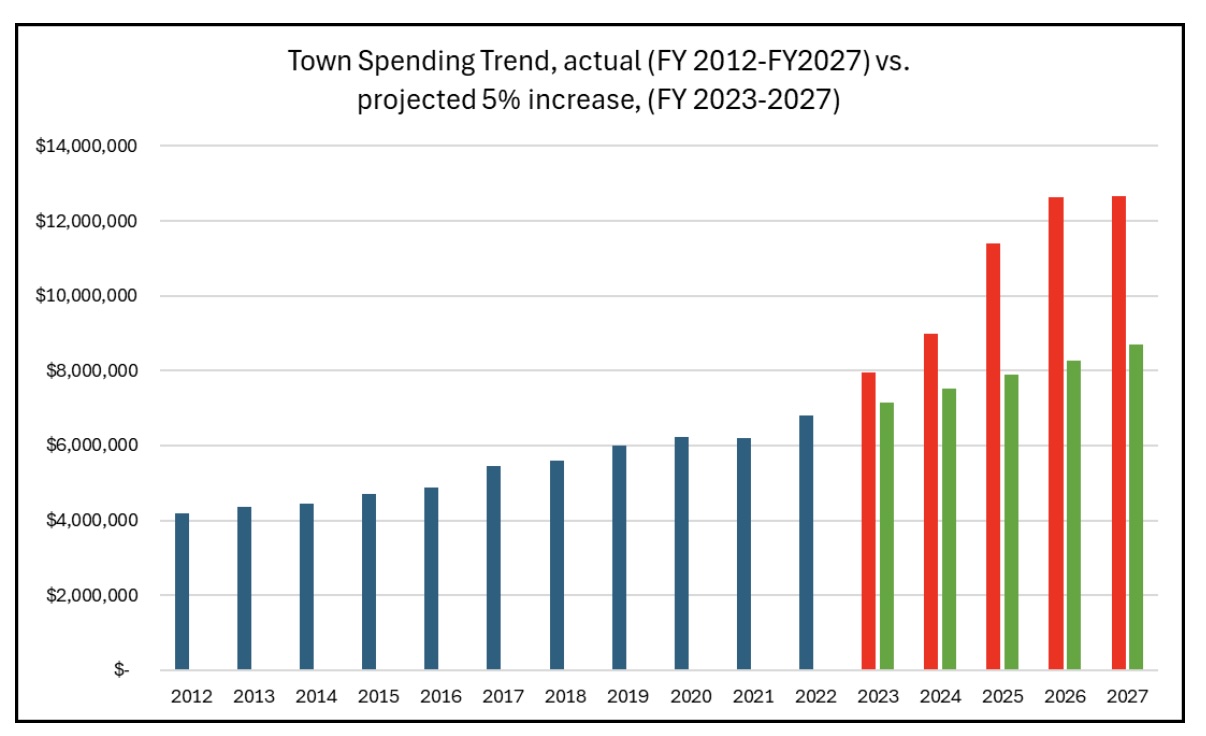
In this chart, the blue bars show actual spending from FY 2012 to FY 2022. Over those years, town spending rose by an average of 5.02 percent a year.
The red bars show actual spending since FY 2022. That spending went up 16.6 percent from FY 2022 to FY 2023, went up again by 13.2 percent the following year, increased a staggering 26.6 percent the year after that, and went up another 10.8 percent last year. In four years, municipal spending grew from $7.9 million to $12.6 million.
To provide a sense of what might have been, the green bars show what the town would have spent if, starting in FY 2023, we had simply stayed on the 5 percent annual growth rate we had enjoyed for the previous decade.
Instead of spending nearly $9 million in FY 2024, for example, we would have spent only $7.5 million. The following year, we would have spent $7.8 million running the town, rather than the $11.3 million that we actually spent.
And this past year? If we had stayed at that 5 percent growth rate the whole time, town spending for FY 2026 would have been $4 million less.
If taxpayers have been feeling the bite of property taxes these last couple of years, this is why.
Again, that we’re being offered a budget with virtually no spending growth is something of a miracle given what we have all been through.
But what is important is that the underlying factors that have driven this recent explosion in spending still remain.
- The number of full-time town employees would remain at 43 under this budget, up from the 29 full-time employees the town had in FY 2022, before spending started to skyrocket. As near as I can tell, the new budget doesn’t cut any municipal positions. (A table showing these staffing changes is conveniently provided on page 278 of the budget document.)
- No changes are being proposed as it regards Emergency Medical Services, which as recently as FY 2023 was provided under a contract that cost taxpayers $93,000. The current budget proposes $1.2 million in spending for EMS, with a net expense of $903,000 once projected revenues generated by the service are factored in. This is ten times what we were spending four years ago.
- We know that a rare opportunity to rethink policing services presented itself with the recent retirement of Chief Gagne, but the budget appears to propose that Rockport continue to operate its own police department, sharing no services whatsoever with Camden or anyone else. Spending on the police would go down slightly from last year, but there is little indication that the kind of creative reimagining around the provision of municipal services that we need has happened, even when a perfect opportunity to do so was dropped into the town’s lap.
And this may be the greatest frustration of all.
At the close of last year’s budget process, I lamented that the budget process made no allowances for the kind of outside-the-box thinking that rising budget pressures demand. There were no tools at hand to tackle the big issues driving the budget, and no interest in or leadership by Rockport’s Select Board to take a regional leadership role and meaningfully explore new ways to provide these services. Little seems to have changed on that front.
I also expressed frustration at the lack of transparency in the budget, and the new budget document does little to address my concerns.
For example, Mr. Duke includes only two charts in his Town Manager’s letter accompanying the budget.
One is a pie chart that the town likes to roll out to show that municipal spending is only 35 percent of the total mill rate apportionment, with schools and the county making up the rest (it is so beloved that it appears a second time on page 35 of the budget document). What that chart conveniently omits is that five years ago, in FY 2021, municipal spending was only 25 percent of mil rate apportionment. The town’s slice of the overall spending pie has increased because its overall spending growth since 2021 (103%) has vastly exceeded that of the schools (24%) or the county (50%).
The other chart that appears in the letter is the mil rate history chart, chosen, no doubt, because at first glance it would seem to suggest the spending is somehow going down—the mil rate is indeed lower now than it was from 2020-2022, for example. But the mil rate, of course, is a function of two factors, spending and property valuation. As Rockport’s property values have skyrocketed, mil rates have necessarily come down, even as municipal spending has more than doubled in five years.
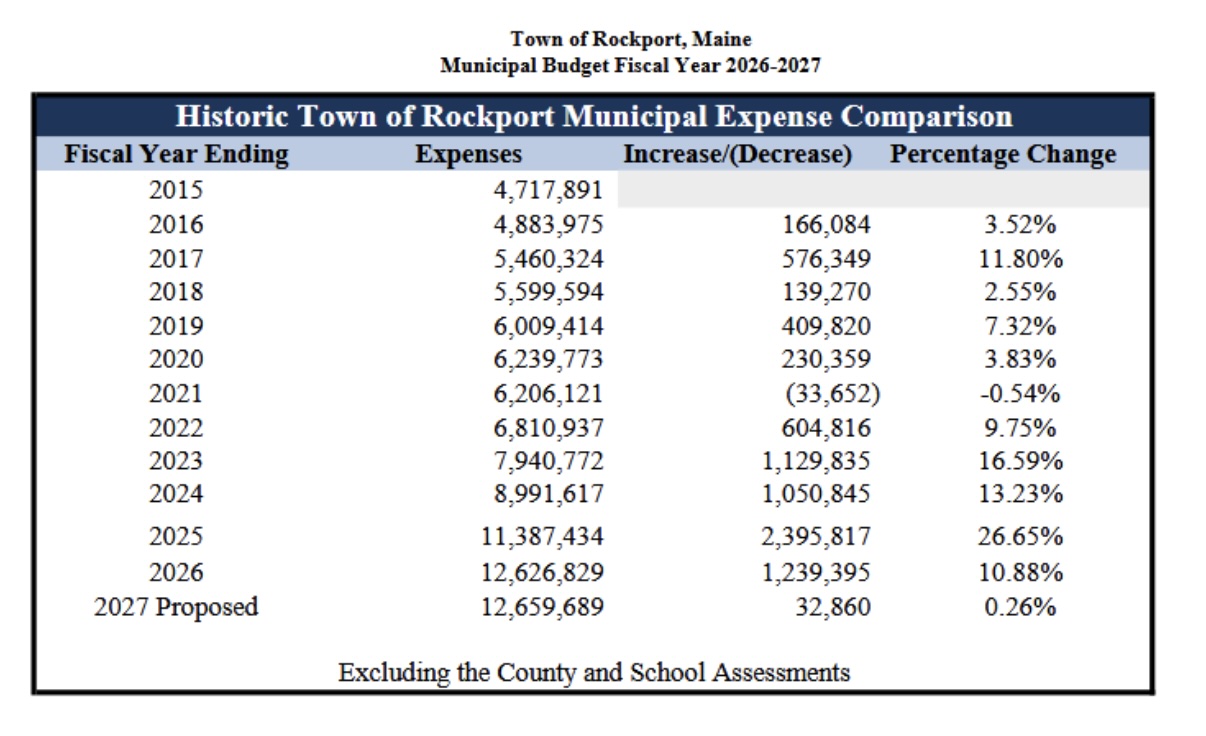
The chart that should have been included in the letter is the one below, showing municipal spending trends. As I noted last year, this chart, or one very much like it, used to appear routinely in the Town Manager’s budget letter. In 2017, for example, it was on page 14 of the budget document. Last year it was on page 73. This year, it can readily be found on page 318.
To conclude, for taxpayers, the next few weeks are critical ones. Mr. Duke will present his budget in series of public meetings, laying out the details of his proposal. At the end of this process, the Budget Committee will make recommendations, and the Select Board will propose a final budget to go before voters in June.
The Select Board, which, as I noted last year, amended the Town Charter in 2023 to prevent the Budget Committee’s up-or-down vote on the budget from appearing on the Town Warrant, has relented to the pressure so many of you provided, with the result that this up-or-down guidance from the Budget Committee will be available to voters this year.
The Select Board has taken no action on a much more important proposal to reverse its own actions and “re-amend” the Charter, permanently restoring the Budget Committee to its historic “citizen watchdog” role. Assuming it refuses to do so, residents should be on the lookout for a signature drive to put a charter amendment on the ballot over the Select Board’s objection.
In summary, where does that leave us? With more to come. And yes, there is some promising news at this point to be sure, though the devil, as they say, is in the details.
Steve Bowen lives in Rockport and serves on the Budget Committee