Half Seas Over: A Flare for the Dramatic
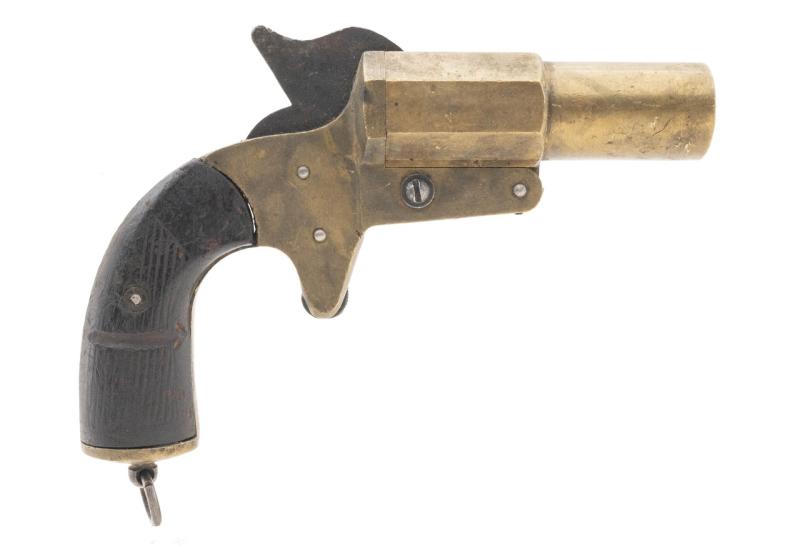 Example of a Very Pistol, this is a WW I U.S. Military Air Service Flare Pistol 1917 (Public Domain, Image courtesy Charles H. Lagerbom)
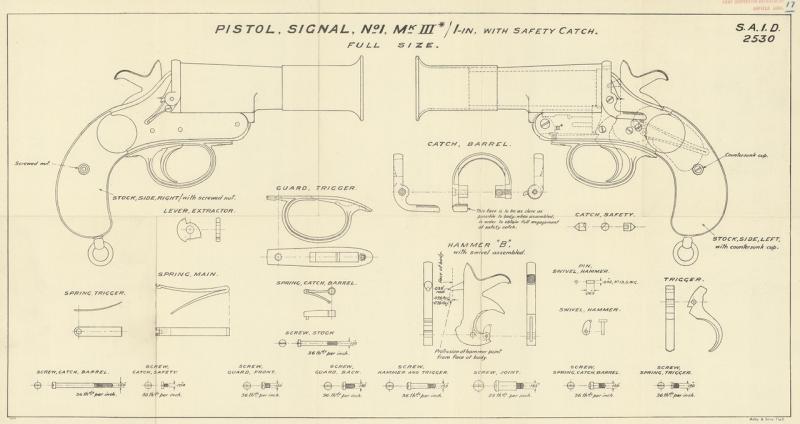 Schematic of a Very Pistol, this is Mark III was Britain’s primary signal pistol of WW I and designed by Webley & Scott; the barrel and action were made of brass to prevent rusting at sea (Public Domain, Image courtesy Charles H. Lagerbom)
 Charles H. Lagerbom’s column Half Seas Over is a maritime reference where one is half sunk or right in the midst of it all (or an allusion to being drunk) He received his M.A in history and archaeology from UMaine and organized shipwreck surveys in Maine lakes, the 1779 Penobscot Expedition and the 17th century English galleon Angel Gabriel. Two field seasons were spent in Antarctica as a glacial geology field assistant for the University of Maine Quaternary Institute, now Climate Change Institute. He is author of Henry R. Bowers: The Fifth Man (1999); Whaling in Maine (2020) and Maine to Cape Horn: The Most Dangerous Journey (2021). His latest book The Hero Way: History and Science of an Antarctic Research Vessel is due Spring 2025. A 30- year veteran teacher, Charles teaches AP US History and is part of the Belfast Marine Institute, dedicated to connecting youth with the maritime world. He speaks on topics regarding Antarctica, Cape Horn, Maine whaling and New England Colonial and maritime history.
Example of a Very Pistol, this is a WW I U.S. Military Air Service Flare Pistol 1917 (Public Domain, Image courtesy Charles H. Lagerbom)
Schematic of a Very Pistol, this is Mark III was Britain’s primary signal pistol of WW I and designed by Webley & Scott; the barrel and action were made of brass to prevent rusting at sea (Public Domain, Image courtesy Charles H. Lagerbom)
Charles H. Lagerbom’s column Half Seas Over is a maritime reference where one is half sunk or right in the midst of it all (or an allusion to being drunk) He received his M.A in history and archaeology from UMaine and organized shipwreck surveys in Maine lakes, the 1779 Penobscot Expedition and the 17th century English galleon Angel Gabriel. Two field seasons were spent in Antarctica as a glacial geology field assistant for the University of Maine Quaternary Institute, now Climate Change Institute. He is author of Henry R. Bowers: The Fifth Man (1999); Whaling in Maine (2020) and Maine to Cape Horn: The Most Dangerous Journey (2021). His latest book The Hero Way: History and Science of an Antarctic Research Vessel is due Spring 2025. A 30- year veteran teacher, Charles teaches AP US History and is part of the Belfast Marine Institute, dedicated to connecting youth with the maritime world. He speaks on topics regarding Antarctica, Cape Horn, Maine whaling and New England Colonial and maritime history.
Charles H. Lagerbom’s column Half Seas Over is a maritime reference where one is half sunk or right in the midst of it all (or an allusion to being drunk) He received his M.A in history and archaeology from UMaine and organized shipwreck surveys in Maine lakes, the 1779 Penobscot Expedition and the 17th century English galleon Angel Gabriel. Two field seasons were spent in Antarctica as a glacial geology field assistant for the University of Maine Quaternary Institute, now Climate Change Institute. He is author of Henry R. Bowers: The Fifth Man (1999); Whaling in Maine (2020) and Maine to Cape Horn: The Most Dangerous Journey (2021). His latest book The Hero Way: History and Science of an Antarctic Research Vessel is due Spring 2025. A 30- year veteran teacher, Charles teaches AP US History and is part of the Belfast Marine Institute, dedicated to connecting youth with the maritime world. He speaks on topics regarding Antarctica, Cape Horn, Maine whaling and New England Colonial and maritime history.
Example of a Very Pistol, this is a WW I U.S. Military Air Service Flare Pistol 1917 (Public Domain, Image courtesy Charles H. Lagerbom)
Schematic of a Very Pistol, this is Mark III was Britain’s primary signal pistol of WW I and designed by Webley & Scott; the barrel and action were made of brass to prevent rusting at sea (Public Domain, Image courtesy Charles H. Lagerbom)
Charles H. Lagerbom’s column Half Seas Over is a maritime reference where one is half sunk or right in the midst of it all (or an allusion to being drunk) He received his M.A in history and archaeology from UMaine and organized shipwreck surveys in Maine lakes, the 1779 Penobscot Expedition and the 17th century English galleon Angel Gabriel. Two field seasons were spent in Antarctica as a glacial geology field assistant for the University of Maine Quaternary Institute, now Climate Change Institute. He is author of Henry R. Bowers: The Fifth Man (1999); Whaling in Maine (2020) and Maine to Cape Horn: The Most Dangerous Journey (2021). His latest book The Hero Way: History and Science of an Antarctic Research Vessel is due Spring 2025. A 30- year veteran teacher, Charles teaches AP US History and is part of the Belfast Marine Institute, dedicated to connecting youth with the maritime world. He speaks on topics regarding Antarctica, Cape Horn, Maine whaling and New England Colonial and maritime history.The Very Light Pistol has been used in maritime rescues and military operations for years. Pretty cool that its inventor was Edward Very, a native of Belfast, Maine!
Born in 1847, his family emigrated west and, at age 15, Edward was admitted to the U.S. Naval Academy. His was the first appointment from the then-territory of Washington.
He took a leave of absence from Annapolis to serve in the Civil War, shipping aboard the Maine-built USS Agawam (more on that ship later) before ending his duties off North Carolina aboard the blockade ship USS Gettysburg.
Back at Annapolis, he graduated June 1867, then served aboard USS Michigan before joining the Asiatic Squadron. There, he served aboard the Maine-built USS Piscataqua and USS Oneida.
In January 1869, he was commissioned ensign and that May ordered to the USS Idaho. His departure was fortuitous, Oneida soon after collided with the British steamer Bombay and sank off Yokohama, Japan. Only 61 of the nearly 200 men aboard were saved.
Tours aboard sidewheel gunboat USS Monocacy and USS Delaware followed before his transfer to the European Squadron. There, he served aboard Maine-built USS Franklin, USS Richmond and USS Shenandoah. He was in Paris in May 1871 and witnessed “Bloody Week” when Marshall MacMahon’s forces entered the city ending the revolutionary movement then convulsing France known as the Paris Commune.
Very next was part of the 1874 Panama Canal Survey, then moved into ordinance. In the later 1870s, he conferred with European military officials in Europe on new and existing armaments.
It was his work in the development of flares, for which he became famous. Very oversaw development of a series of flares and lights for signaling at sea. These early signals were not launched into the air but rather waved at arms-length. Still, they proved effective and became known as Very Lights.
Later, he developed a gun to launch these lights into the air for better signaling range. This came to be known as the Very Pistol, most common type of flare gun. It is a simple single-shot breech-loading snub-nosed pistol. Very basic, it has a single action trigger, hammer action and center fire pin.
Very Pistols were considered new and useful improvements in pyrotechnic signal cartridges. His U.S. #190263 patent was dated May 1, 1877. However, the idea of a hand-held gun sending up flares into the sky already existed.
Benjamin Franklin Coston was a young inventor in the 1840s who dabbled in flares and chemical signals. When he died from chemical poisoning in 1848, he left four children and a young widow, Martha Jane Coston.
To feed her family, Martha continued his research and work on flares, gaining a reputation in the field. Coston’s Telegraphic Night Signals became regularly used in maritime and military operations. In 1871, she came up with a twist-ignition device that she patented.
It was Coston's son who invented the first aerial flare launching cartridge. But his mother, Martha Jane, apparently jealous of her son’s invention, used her considerable clout to lobby against it being accepted by the Navy.
As a result, in 1882 the U.S. Navy adopted Edward Very’s pistol and cartridge and Very received credit for the idea. By 1900, his pistol and lights were in use around the world and popularly known as the Very Pistol and Very Lights. In WW I, they were used by American pilots to shoot down balloons and planes on the Western Front.
Edward Very finished his career in the Navy on special assignments abroad. He published four works on naval armaments, including his 1880 major work entitled “Navies of the World” about the armament and armor of the naval vessels of 20 leading nations.
Upon retirement from the Navy, he joined the arms manufacturer Hotchkiss, where in 1885 he published a book on The Hotchkiss Revolving Canon. His final employment was with the American Ordinance Company.
Edward Wilson Very married Margaret Zeilin, daughter of the Commandant of the Marine Corps. In 1910, he died of pneumonia in New York City.
Today, Very’s invention is still fundamentally seen as an emergency survival tool, a critical piece of maritime equipment. A great many people owe their lives to his design, it has saved countless people since first introduced over a 140 years ago.