
How the Camden, Maine, skate culture outgrew its rebel roots
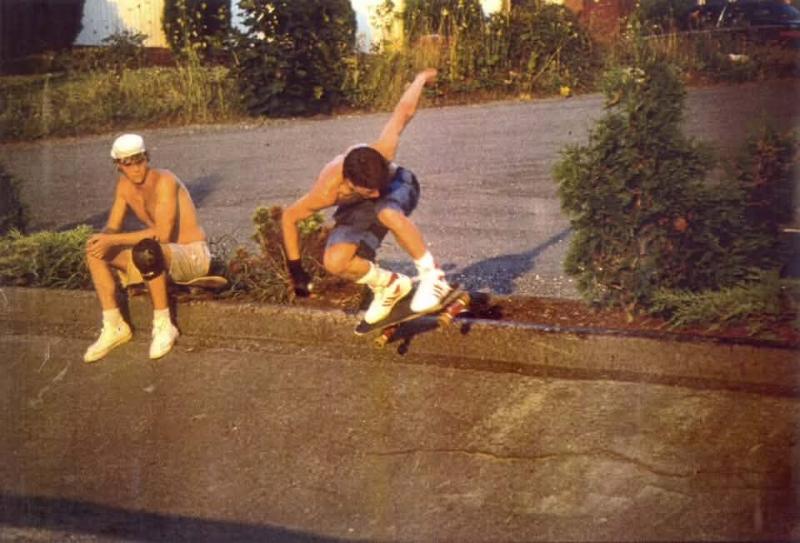 Gen X skaters Justin Stephens and Chris Schmidgall skating "The Ditch" in Rockport, circa 1990. A knee brace and air cast reveal the typical injuries of that time. Photo courtesy Chris Schmidgall
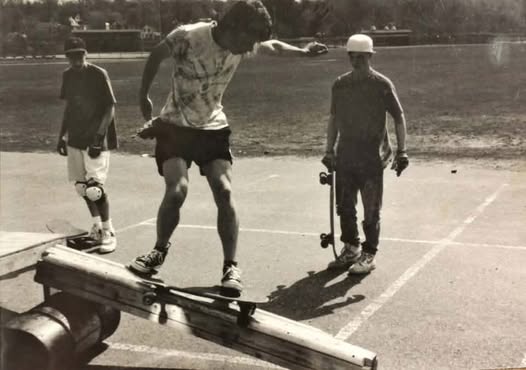 Circa 1989-1990. Skating behind Mary E. Taylor middle school in Camden. L to R: Josh Provonchee, Chris Schmidgall, and Noah Shepard. Photo courtesy Adam Shepard.
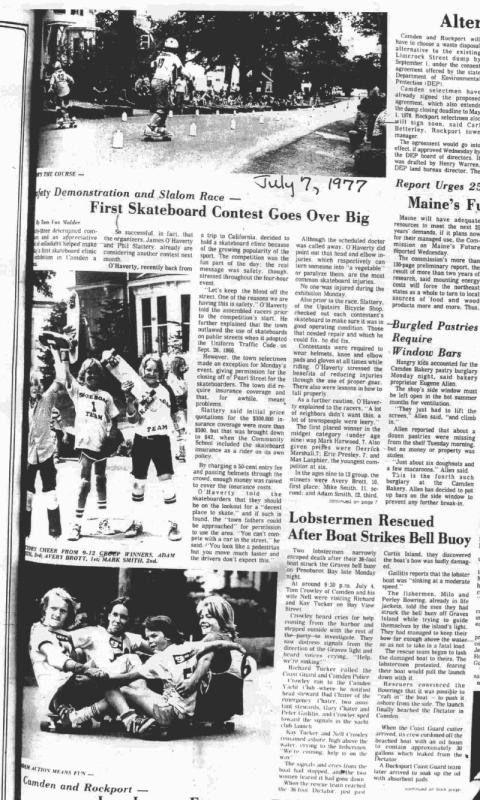 Screenshot of the 'Camden Herald' story in 1977 featuring the town's first legal street skateboarding contest.
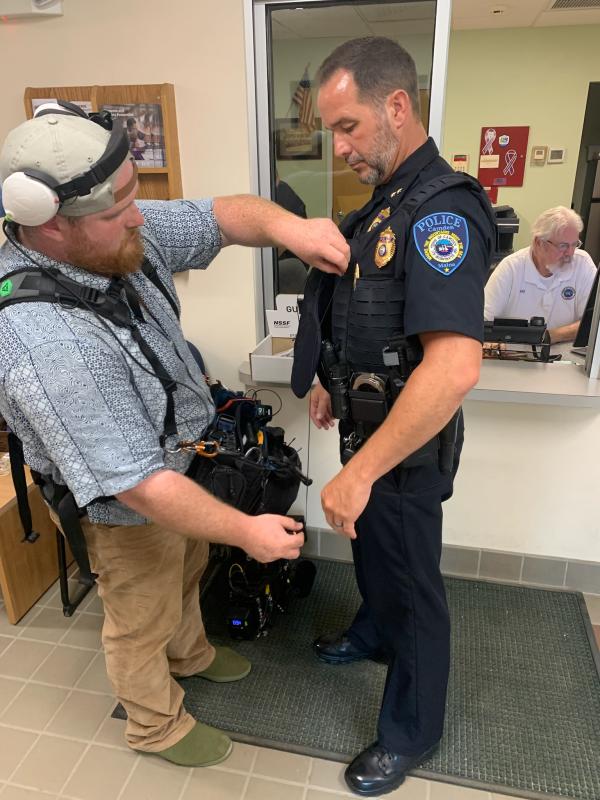 Allen Weaver, Camden's chief of police, getting ready for a scene in the skater movie "Hope is Hip." Photo courtesy Gideon Baeza
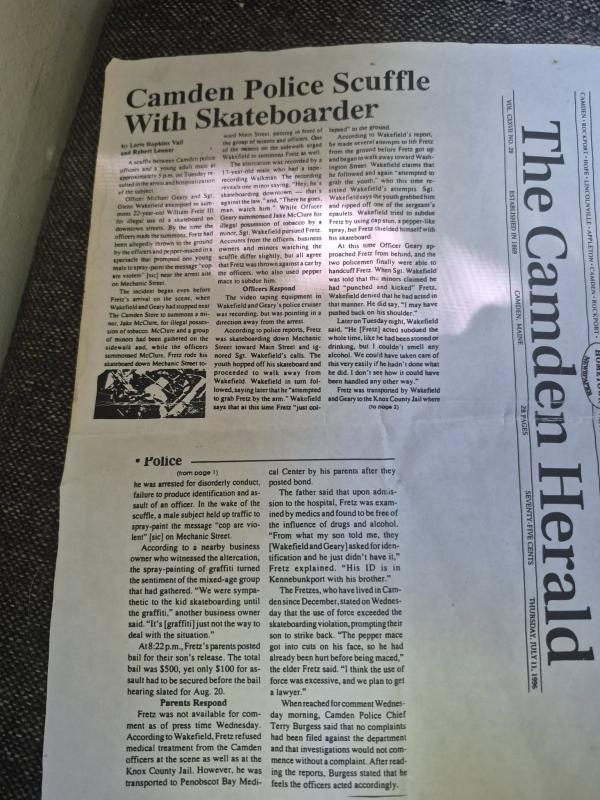 A screenshot of the 1996 The Camden Herald story of an altercation between a skateboarder and the police.
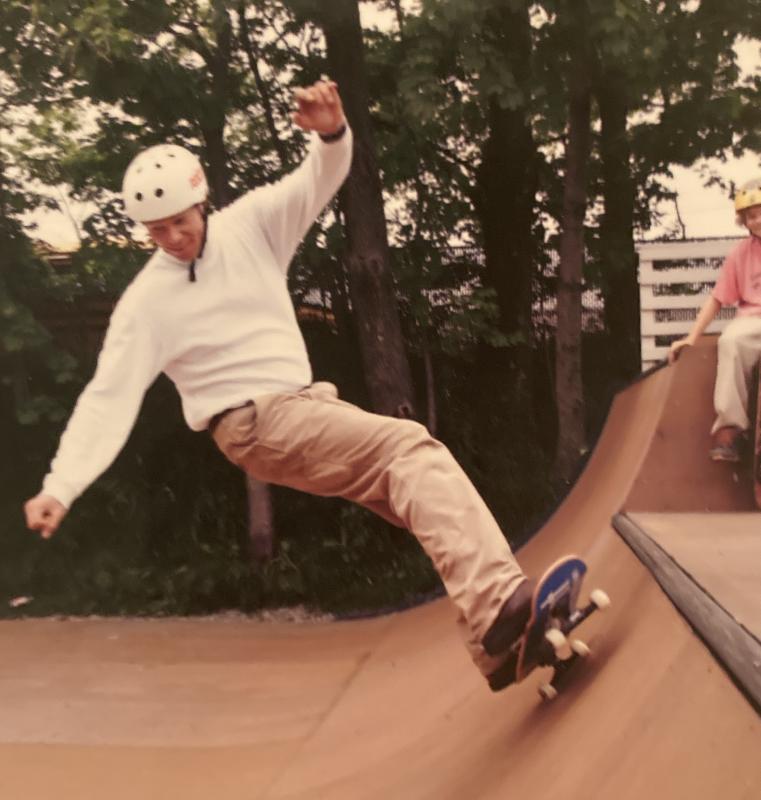 Jeff Lewis at The Teen Center skate park in the 2000s. Photo courtesy Polly Lewis
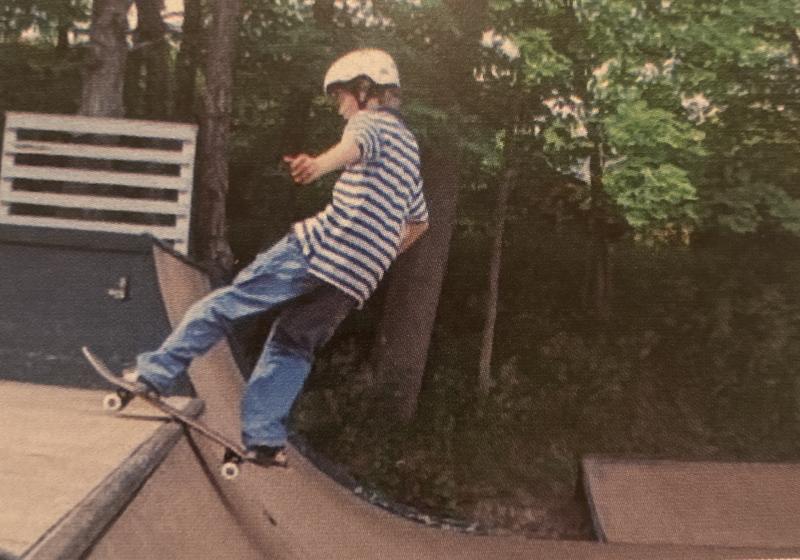 Robin Lewis, Jeff's son, at The Teen Center skate park in the 2000s. Photo courtesy Polly Lewis
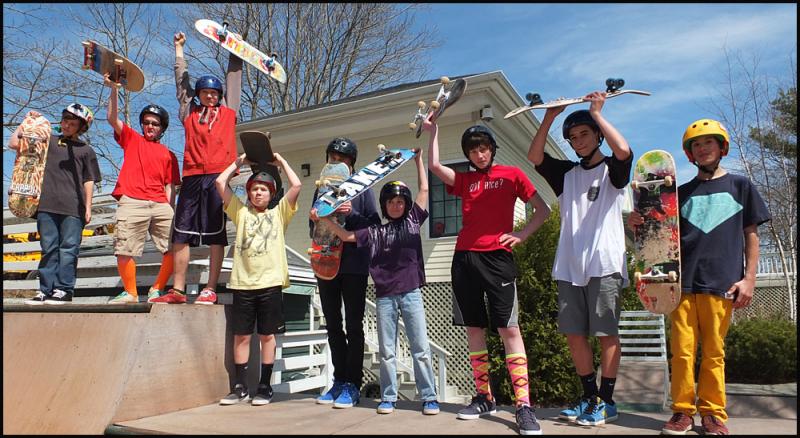 A blast from the past: 2014: Teen Center skateboarders Gideon Baeza, Don Aviles, Simon Turner, Evan Yander, Connor O’Gwer, Tristan Anderson, Adian Aviles, Seth Yates, Jessy Fraser and Theo Penney. Photo by Chris Wolf
Gen X skaters Justin Stephens and Chris Schmidgall skating "The Ditch" in Rockport, circa 1990. A knee brace and air cast reveal the typical injuries of that time. Photo courtesy Chris Schmidgall
Circa 1989-1990. Skating behind Mary E. Taylor middle school in Camden. L to R: Josh Provonchee, Chris Schmidgall, and Noah Shepard. Photo courtesy Adam Shepard.
Screenshot of the 'Camden Herald' story in 1977 featuring the town's first legal street skateboarding contest.
Allen Weaver, Camden's chief of police, getting ready for a scene in the skater movie "Hope is Hip." Photo courtesy Gideon Baeza
A screenshot of the 1996 The Camden Herald story of an altercation between a skateboarder and the police.
Jeff Lewis at The Teen Center skate park in the 2000s. Photo courtesy Polly Lewis
Robin Lewis, Jeff's son, at The Teen Center skate park in the 2000s. Photo courtesy Polly Lewis
A blast from the past: 2014: Teen Center skateboarders Gideon Baeza, Don Aviles, Simon Turner, Evan Yander, Connor O’Gwer, Tristan Anderson, Adian Aviles, Seth Yates, Jessy Fraser and Theo Penney. Photo by Chris Wolf
CAMDEN— Nothing says "rolling with the times" like skateboarding.
While skateboarding technically became a hobby sport in the 1950s, it really took off in the 1970s. Gen X youth dominated this DIY sport, turning it into a rebellious subculture, with competitions in California like the Zephyr Competition Team (Z Boys) pioneering what was to become an anti-establishment, punk-infused skate culture that spread state to state.
When skate parks across the country began to close because of increased injuries and owners afraid of being sued, skaters took to the streets. As the skateboarding experience exploded, it faced massive legal crackdowns and street bans. Skateboarding across the country began getting banned on sidewalks, public streets, and plazas, largely due to accidents, injuries and property damage.
Camden's burgeoning skate culture
Kids who grew up with skateboards in Camden often took to the streets, as well, even though for the last 60 years, street skateboarding in certain sections of downtown Camden was prohibited.
A July 7, 1977 article in The Camden Herald titled, "First Skateboard Contest Goes Over Big," posted by the Facebook group Skateboard History of Maine, announced Camden's first skateboard contest. Despite some local opposition, it turned out to be a great success.
James O'Haverty, a co-organizer of the event, told the paper, "...the town outlawed the use of skateboards on public streets when it adopted the Uniform Traffic Code on Sept. 26, 1966." He further explained, "A lot of the neighbors didn't want this; a lot of the townspeople were leery."
Camden's municipal Traffic Code (Chapter 250) Article XI explicitly restricts skateboards, non-motorized devices, and bicycles in any portion of the Town designated as a Central Business Zone (B-1 or HB) to protect pedestrian and driver safety. If a skateboarder is under 17, state law grants police the power to impound the skateboard until a parent or guardian goes to the police station to retrieve it.
Gen Xer Justin Stephens, who grew up skating in both Boston and Camden, said his friends had homemade ramps in barns they used to practice on, but that they often took to the streets.
"It was about counter-culture, rebelliousness, and it was just fun," he said. "Somehow, hurting yourself skating was a badge of pride. And, for many of us, it was a mode of transportation. We didn't have the money for cars; I couldn't even afford a bike."
All throughout the 1980s and into the 1990s, the police gave warnings and, sometimes, citations to skateboarders who flouted the law. That was part and parcel of kids being kids and the police doing their jobs.
“Usually we’d give people a warning," said Camden Police Chief Allen Weaver, looking back on those years. Violations have not changed since then. "The first offense is a $25 fine. The second offense is a $50 fine. Any fine after that is $100. And sometimes, we had to confiscate the skateboard and have their parents come pick it up, but it was rare to issue anyone a civil summons."
Weaver recently played a police chief in a feature film directed and financed by former Camden teen skateboarder, Gideon Baeza, called "Hope is Hip." See that PenBay Pilot story here.
Weaver said the film was like coming full circle, having known Baeza as a teenager in Camden, skating around.
"I grew up with my dad as a police officer," Weaver recalled. "My dad was the chief of police in Belfast, and I was in the paper a few times as a teen, doing things the chief of police’s son should not be doing.
"Part of the film's script was based on real life," he continued. "We have the community and the Select Board we have to answer to. I have always supported the skate park, but we can’t allow certain behaviors. In my whole career, I’ve tried to make connections with all of the skaters, just because to me, community policing is being involved with everyone."
Weaver first began policing in 2003.
"One of my first interactions with skaters was driving down Knowlton Street and coming across these kids building a ramp," he said. "And Knowlton Street is a no-skate zone. They were super nervous when we pulled up, immediately moving their stuff out of the way and we — Officer Hall — and I were just like, 'Hey, guys, just be safe.’ One of the kids who has grown up now, and I know him still remembers us being cool about it."
He recalled other incidents.
“Most of the time the kids adhered to the warnings," said Weaver. "Sometimes you’d get pushback. You had some trash talkers, but that’s all part of the job. I remember starting as a brand new officer, working the 2 a.m. to 6 a.m. shift, sitting in my cruiser down on Bay View, and watching kids skate down in the summer, racing each other. Then they'd see me, bail off their boards, and run behind the Waterfront. We’d go find them and talk to them all. The violation didn't rise to cutting them a fine."
1996 Police Altercation
In 1996, tension between skaters and the police reached a flashpoint when William Fretz, 22, skated illegally down Mechanic Street.
According to an article in the July 11, 1996 issue of The Camden Herald titled "Camden Police Scuffle with Skateboarder," Officer Michael Geary and Sgt. Glenn Wakefield attempted to summons Fretz for skating downtown.
According to the article, "By the time the officers made the summons, Fretz had been allegedly thrown to the ground by the officers and pepper-maced in a spectacle that prompted one young male to spray paint the message 'cop are violent' [sic] near the arrest site on Mechanic Street."
There was tension not only between young adults and the police in Camden, particularly when they congregated in public areas like the Camden Amphitheatre, but also mistrust between skateboarders and the police. The rebellious anti-authority spirit of skaters was palpable.
By contrast, it was a different feeling in Boston. "In Boston, the police would watch us, cheer us on and clap, because they knew we were just skaters and not hard criminals," said Stephens. "They had real criminals to deal with. In Camden, the police didn't have much to do but pick on us."
The Teen Center's Skate Park
In 2000, the corporation MBNA built a skate park on Knowlton Street, which was, ironically, one of the streets where it was illegal to skate. In 2009, when MBNA began divesting its properties, the future of the skate park was in jeopardy. The Teen Center then took over the skate park.
Jeff Lewis, who lives in Camden, grew up surfing and skateboarding in the mid-1970s and 1980s. By the time he was in his early 30s and moved to Maine, he’d given up skateboarding, but took it back up again when his boys were growing up.
“We moved right by Knowlton Street," he said. "Some board members of the Teen Center, knowing that I was a skater and had boys who skated, asked me to join the board. I became head of the board of the Teen Center because I was really interested in keeping the skate park intact.
“We would be there even when it was closed,” he admitted, laughing. “After dinner, we’d plan what we called ‘Expression Sessions,’ get on our boards and just do stuff down Knowlton Street. I was more surf style; they were more street-slasher style.”
Lewis was fully aware of the Camden ordinances against skateboarding in certain areas. And, even though he was the head of the board of the Teen Center, a professional boat captain, and an Episcopal priest, he and his boys still skated down Knowlton Street.
“I never saw any citations or board confiscations," he said. "I always had a good relationship with the cops. But I actually got stopped by a cop one day with my boys on Knowlton. He was maybe 10 years younger than me, and he scolded me for skateboarding. I was gracious. I might have smirked, but I said, 'Okay.'
“I would tell my boys, ‘Be chill when you’re downtown. Don’t skate on the skatewalk.' When I was a kid, I did that and lost my board one day, shattering a glass plate window at a mall. I didn't mean to and immediately went to the owner to apologize and offer to pay."
Community and Business Owner Wariness
“I think in the early days with the older business owners, people had a negative impression of skaters, because the kids looked and dressed a certain way,” said Weaver.
In a PenBay Pilot interview with filmmaker Baeza, he said: "Time and time again, growing up here, I've seen..skate parks get a bad reputation. I think it's a stereotype, and sometimes it's justified," noting that very few kids smoked pot and drank alcohol.
“We still get complaints like that at the skate park," said Weaver. "We know there might be one or two people doing things they shouldn’t be, but the vast majority, like 95 percent, just go there to skate and hang out with their friends. We'd have neighbors sitting outside in the summer who'd call us and say, ‘I can smell marijuana over there,’ but marijuana is now legal. And we have a lot of adults who use the skate park, so technically they are not supposed to be smoking in a public area, but it’s not like all of these kids are doing drugs. We’re up there all the time several times a day and never finding needles there."
In 2020, the YMCA sold the Teen Center and the town relocated the skate park to a nearby town-owned parking lot. The town has since raised funds to repair the aging ramp infrastructure, and the skate park continues to stay open.
Now that the skate park has moved away from the direct supervision of the Teen Center, Weaver said he thought the skaters felt a little more free.
“We still stop by several times a day,” he said. “We’re still keeping an eye on the place to make sure nothing gets out of hand. Once they realize we’re on their side, they know we’re not after them. We want to hang out and talk."
The Swastika Incident Gets Pinned on Skaters
In 2024, a PenBay Pilot story reported that graffiti of a swastika had been painted on Main Street. According to the article, “The graphics reportedly were discovered on Main Street and included a swastika and Holocaust reference.”
A Bangor Daily News article dated 2024 further detailed: "The image in Camden, which was placed on the side of the building on Bay View Street, featured an altered picture of a swastika...and other Holocaust references, according to Camden Police Chief Randy Gagne.”
In response to this incident, Weaver said: "Of course everyone blamed the skaters. But we discovered it was a kid who never went to the skate park. Anything negative that happens is automatically pinned on the skaters. When we spoke to them, the kids at the skate park told us, 'No, it wasn’t one of our people, and we’d tell you, because we don’t want to be associated with that.’”
Lewis, having spent much time skating at both skate parks with his kids and their friends, concurred.
“I was not around when that happened," he said, "but my boys and the kids they hung around with were good kids. And they weren’t going to destroy what they loved. The Nazi stuff would have made them sick."
Gen X's rebellion tapers off with Gen Z and Gen Alpha
These days, Camden is still the way Camden has always been for skaters, a pavement playground — it's not uncommon to see younger kids bombing down Mechanic Street on boards or scooting along on their ride-on or electric scooters.
Which begs the question. If skating downtown is still illegal, are the police still cracking down?
“We’re not going to go chase a kid who is just skating to get somewhere,” said Weaver. “They’re using their boards to go to French and Brawn and get a snack and go back to the skate park. If it’s not a nuisance, we’re not going to do it, unless we get a call that it's a problem.
“The kids are not as rebellious as the previous skate culture; they’re not trying to fight the system," he added. "When you come up in that skate culture, everything is more relaxed these days, especially in Camden. We’re not getting the calls we used to get when I first came on the force. I also think the citizens’ perception of skaters—many of them being Gen X—has changed. Skaters are not getting as bad of a rap as they used to. And kids aren’t hanging out in public places anymore. Only the skate park kids do now.
"I go out and talk to them all the time," said Weaver. "They realize we’re on their side, that we’re not after them, we want to just hang out and talk to them. The kids would walk by on their way to French & Brawn and yell, ‘Yo Allen!’ and they know we’re there.”
On an unseasonably warm October afternoon after school, a group of middle school kids and one high school-aged teen can be found at the skatepark. They're not dressed edgy or trying to stand out. Long-sleeve shirts and pants in muted colors. All wear helmets. No music blaring. Occasionally, one skater practices form on a ramp, but most of the kids seem content to hang out and talk. This is their third place where no one can bother them, and they can just practice, fall, screw up, or nail it. And they couldn't care less what adults think of them.
Kay Stephens can be reached at news@penbaypilot.com