
Electricity customers voice concerns over CMP’s latest rate proposal
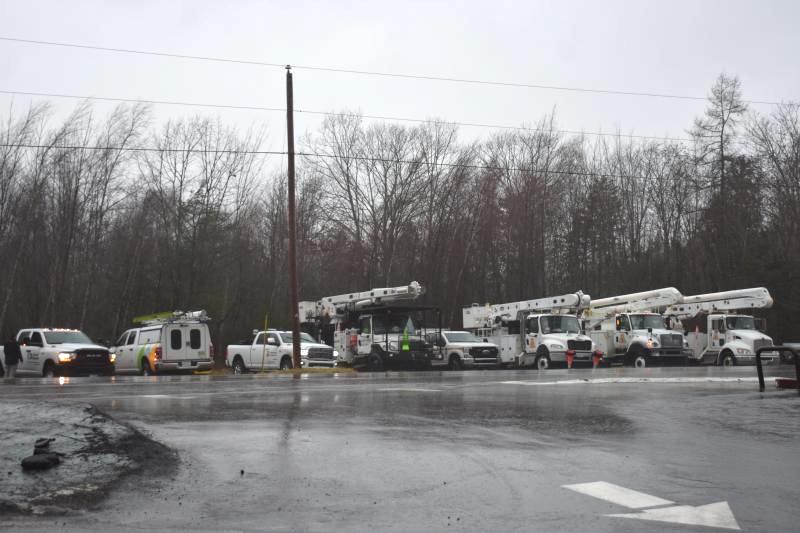 Linemen stage in a parking lot at the intersection of routes 17 and 220 in Washington during a December 2023 storm. (Photo by Sarah Thompson/PenBayPilot.com)
Linemen stage in a parking lot at the intersection of routes 17 and 220 in Washington during a December 2023 storm. (Photo by Sarah Thompson/PenBayPilot.com)
Linemen stage in a parking lot at the intersection of routes 17 and 220 in Washington during a December 2023 storm. (Photo by Sarah Thompson/PenBayPilot.com)
On Tuesday, Central Maine Power customers sounded off about their electricity bills at a public hearing on the utility company’s latest request to set new distribution rates, which could increase those bills by more than $200 over the course of a year.
Demonstrators opposing the proposed rate increase held signs reading “Fight the hike” and “No sneaky rate hike” outside the Lewiston public library where the hearing took place. They acted out a tug-of-war between Maine ratepayers and what they called “CMP profiteers.”
Some attendees supported the utility’s request. Inside the library’s meeting room, a couple dozen electrical linemen wearing union and contractor T-shirts took up the last two rows of seats and spoke in support of Central Maine Power’s plan to hire more local workers.
The company, which serves more than 670,000 customers in southern and central Maine, has said it needs to increase rates to maintain reliable service, especially as climate change leads to worse storms. The proposed rate increase would take effect in stages and average out to approximately $18 per month for a residential customer who uses 550 kilowatt-hours of electricity in a month, according to the Maine Public Utilities Commission. The request must be approved by the three commissioners, who are appointed by the governor and will act as the judge and jury in what’s expected to be a year-long deliberation.
This rate request has drawn an unusual amount of scrutiny and public engagement. Late last year, the commission rejected an earlier proposal by Central Maine Power that would have increased rates by approximately $35 per month for the average residential customer over five years. That decision marked the first time the Public Utilities Commission has outright rejected a distribution rate proposal.
“At a time when the Legislature has prioritized grid planning and performance standards, and affordability is a top concern, CMP’s proposal misses the mark,” the commission’s chairman Philip Bartlett said in a statement at the time.
Approximately 100 people attended this week’s public hearing, far more than past hearings, according to commissioners and advocates.
Several members of the public who spoke at the hearing said they were retired or disabled and living on fixed incomes, and urged the commissioners to reject Central Maine Power’s request.
“I already pay as much as I can afford for electricity,” said Siiri Cressey, a Lewiston resident who said she does not have an air conditioner or laundry machines and unplugs other appliances when she’s not using them. “I don’t have any more corners that I can cut.”
Another Lewiston resident, Melissa Dunn, said she didn’t even have a stove and had replaced her full-size refrigerator with a mini-fridge in order to save on electricity.
While most people who spoke opposed a rate increase, some urged the commissioners to support the company’s request. One was Nick Clark, a utility superintendent at Atlantic Power Constructors and a member of the International Brotherhood of Electrical Workers’ Local 104 line workers’ union, who said the increase would support well-paying jobs and help sustain Maine’s middle class.
“We all recognize the challenges presented by Maine’s aging infrastructure and evolving energy needs,” he said. “This proposal prioritizes Maine’s workers and ensures that people responsible for building, maintaining and restoring critical infrastructure are members of their own communities.”
CMP has said the rate increase is meant to cover thousands of stronger distribution poles, hundreds of new smart devices that can restore power faster during outages and upgrades at dozens of substations. Some of the money would also go toward expanded tree maintenance and the hiring of 100 additional workers, including more than 35 local line workers. Currently during storms, Central Maine Power often has to bring in crews from out of state to work on repairs.
Messages from the company and from state agencies about the rate proposal have been confusing and at times conflicting. When publicizing its request in April, Central Maine Power, which is owned by Avangrid, a U.S. subsidiary of the Spanish energy company Iberdrola, emphasized that starting this July the average residential customer’s monthly bills would fall by $4 compared to what customers are paying currently.
An analysis from the Maine Office of the Public Advocate explained that Central Maine Power has been billing customers about $11 a month in temporary surcharges to cover the costs of repairing storm damage from previous years. Those surcharges are set to end in July.
In the first stage of its new rate proposal, the utility is requesting a temporary rate increase of about $7 a month. This was also proposed to start in July, which would partially counteract the expected savings from the end of the storm surcharges. The temporary rate increase is necessary to cover maintenance and reliability upgrades that have already been done, according to the company. The Public Utilities Commission has not yet made a decision on whether to approve this temporary rate increase while it considers the full proposal.
The second stage of the rate increase, proposed to take effect in May 2027, would add an average of $11 more per month, to add up to the $18 total increase compared to what customers were paying before the storm surcharges.
“This is a complex proposal, and Maine people deserve a clear and transparent understanding of how it could affect their bills,” Public Advocate Heather Sanborn said in a statement in April. “CMP’s filing makes clear that the company is not only seeking to recover higher operating costs and capital investments, but also to increase its profits. This comes at a time when Maine families are already facing the rising costs of everything from gas to groceries and housing.”
Part of the company’s rationale for needing more money is to prepare the electric grid to withstand more extreme weather from climate change, at a time when electricity demand is rising.
“This plan also allows us to continue the progress CMP has made in reducing both the frequency and duration of outages,” said Linda Ball, president and CEO of Central Maine Power, in a written statement. “Our focus remains on preventing outages whenever possible and restoring power more quickly when they do occur.”
Many speakers at the public hearing were concerned about climate change, and some had taken steps to transition away from fossil fuels and make their homes more efficient – replacing their oil heaters with electric heat pumps, replacing combustion engine cars with electric vehicles and installing solar panels.
David Bilski has done all that. Although the solar panels help, he said he still has to buy a significant amount of electricity from the grid, and he opposes the rate increase.
“Is this how Maine should reward its citizens whose values and actions align with the state’s laudable climate action goals? How many average Mainers do you think will be willing and able to take the positive steps that we’ve taken when they see that a multinational power conglomerate will be allowed to treat them like their own captive ATM?” Bilski asked.
In total, the requested increase would give the utility approximately $190 million more in revenue over the year.
Central Maine Power, as well as its northern counterpart Versant, is currently limited by state regulations to making a maximum 9.35 percent return on equity. The company is pushing to raise that cap to 9.8 percent, citing a need to improve its credit rating and raise more capital.
The proposal would not affect ratepayers’ entire bill, which is divided into delivery costs and supply costs. Electric utilities including Central Maine Power are only responsible for delivery — the poles and wires that transport electricity — which is regulated by the Public Utilities Commission. Other companies are responsible for the less regulated supply side — the gas and oil power plants, hydroelectric dams, solar and wind farms that actually generate electricity.
Mainers’ electric bills have risen significantly in recent years both because of storm surcharges on the delivery side and volatility in the price of natural gas on the supply side.
The Public Utilities Commission has also been holding technical conferences this month to discuss Central Maine Power’s request. In July, the commissioners will begin hearing from stakeholders who have filed to participate in the case as intervenors, including labor unions, a ratepayers’ union, nonprofit organizations, companies and industry groups. Members of the public can continue to submit written comments about the case online. The commission expects to make a decision in April 2027.
This story was originally published by The Maine Monitor, a nonprofit civic news organization. To get regular coverage from The Monitor, sign up for a free Monitor newsletter here.